CBH Talk | Maya Kornberg and Julian Zelizer Discuss “Stuck”
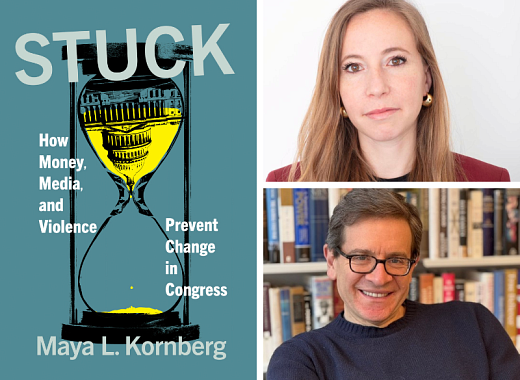
Congress, the central democratic institution in the United States, is hanging on by a thread. In Stuck: How Money, Media, and Violence Prevent Change in Congress, political scientist Maya Kornberg chronicles the efforts of congressional reformers over the last fifty years, and documents the mounting forces that have kept their reforms from creating meaningful change. Join her for an important conversation with historian and political analyst Julian Zelizer, as they examine why this body has proven so resistant to reform and what that stubborn inertia reveals about the state of our democracy.
From the reform-minded “Watergate class” of the 1970s to today’s hyper-polarized Congress, rising political violence, skyrocketing campaign costs, relentless fundraising pressures, shrinking staff capacity, toxic social media, and centralized party leadership have steadily narrowed lawmakers’ ability to legislate. Bolstered by dozens of interviews with current and former members of Congress, Kornberg’s book illuminates how internal congressional dynamics have weakened the institution and ceded power to an increasingly expansive executive branch.
At the same time, Stuck outlines concrete, achievable reforms that could restore Congress’s capacity to function and amplify the influence of its newest members. At a moment when public faith in democratic institutions is dangerously eroding, join us for a conversation that confronts the urgent question: how do we make democracy work for those it is meant to serve?
Participants
Dr. Maya Kornberg is a Senior Research Fellow at the Brennan Center for Justice at NYU Law. She is the author of Stuck: How Money, Media, and Violence Prevent Change in Congress (Johns Hopkins University Press, 2026) and Inside Congressional Committees: Function and Dysfunction in the Legislative Process (Columbia University Press, 2023.) She has taught political science at NYU, Georgetown, and Oxford and worked at the UN and Inter-Parliamentary Union and at democracy focused non-profits. Her writing and commentary have appeared in NPR, Forbes, The Washington Post, Newsweek, Slate, among other outlets. She is dedicated to making democracy work for the people it is meant to serve.
Julian E. Zelizer is a New York Times best-selling author and the Malcolm Stevenson Forbes, Class of 1941 Professor of History and Public Affairs at Princeton University. He is a columnist for Foreign Policy and publishes a popular Substack called The Long View. A regular guest on NPR’s Here and Now, Zelizer is also a prominent analyst on numerous television and radio networks. He is the award-winning author and editor of 27 books, including The Fierce Urgency of Now: Lyndon Johnson, Congress, and the Battle for the Great Society, which won the D.B. Hardeman Prize for the Best Book on Congress, and Fault Lines: A History of the United States Since 1974. His book Burning Down the House: Newt Gingrich, the Fall of a Speaker, and the Rise of the New Republican Party was named an Editor’s Choice and one of the New York Times 100 Notable Books of 2020. Recent books include In Defense of Partisanship, Our Nation at Risk: Election Security as a National Security Issue (co-edited with Karen Greenberg), Myth America: Historians Take on the Biggest Lies and Legends About Our Past (co-edited with Kevin Kruse), The Presidency of Donald J. Trump: A First Historical Assessment (editor), and Abraham Joshua Heschel: A Life of Radical Amazement. Zelizer has published over 1,500 op-eds and received fellowships from the Brookings Institution, the Guggenheim Foundation, the Russell Sage Foundation, the New-York Historical Society, Penn Washington, and New America.
He is completing two new works: a book about the Mississippi Freedom Democratic Party and the 1964 Democratic Convention, titled (forthcoming, Norton, January 2027), and an edited volume The Presidency of Joseph R. Biden Jr.: A First Historical Assessment (forthcoming, Princeton University Press, April 2026).
Center for Brooklyn History programs are made possible in part by the New York State Legislature and the Office of the Governor.