CBH Talk | Heather Ann Thompson on the Legacy of Bernie Goetz
In 1984, a white New Yorker named Bernie Goetz shot four Black teenagers on a subway train, igniting one of the most explosive public debates in modern New York history. Hailed by some as a hero and condemned by others as a vigilante, Goetz became a flashpoint for national anxieties about crime, race, fear, and who is entitled to safety in public space.
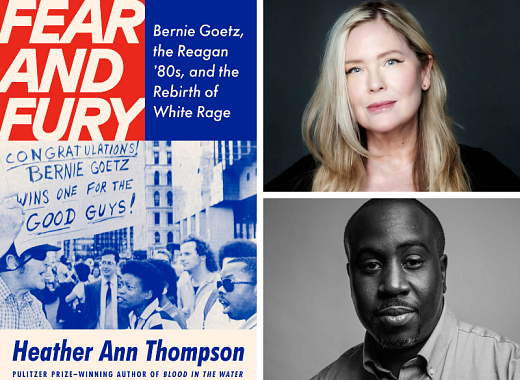
In her new book Fear and Fury: Bernie Goetz, the Reagan '80s, and the Rebirth of White Rage, Pulitzer Prize–winning historian Heather Ann Thompson revisits this moment not as an isolated incident, but as a turning point in American political culture, one that helped normalize vigilantism and laid groundwork for the rise of hate crimes in the decades that followed. Drawing on newly uncovered sources and deep historical context, Thompson traces how Goetz’s shooting of Darrell Cabey, Barry Allen, Troy Canty, and James Ramseur reshaped public discourse, media narratives, and policy, revealing how fear was weaponized and racialized in ways that continue to shape our politics today. The story becomes a lens through which to understand mass incarceration, “tough on crime” governance, and the enduring consequences of framing violence as self-defense.
Thompson will be in conversation with journalist, scholar, and co-host of Uncivil and Empire City, Chenjerai Kumanyika. Together, they will explore how the Goetz case reverberates through contemporary debates about policing, public safety, and racial justice, and what it can teach us about the stories we tell and are told, in moments of crisis.
Heather Ann Thompson photo credit: © Lisa Spindler Studio
Participants
Heather Ann Thompson is a historian and the Pulitzer Prize and Bancroft Prize-winning author of Blood in the Water: The Attica Prison Uprising of 1971 and Its Legacy. Thompson is also the author of Whose Detroit?: Politics, Labor, and Race in a Modern American City. She writes regularly on the criminal justice system for myriad publications, including The New York Times, The Washington Post, TIME, The Atlantic, and The New Yorker. Thompson’s policy work includes serving on a National Academy of Sciences blue-ribbon panel that studied the causes and consequences of mass incarceration in the US. She also co-runs the Carceral State Research Project at the University of Michigan.
Chenjerai Kumanyika is assistant professor of journalism at New York University and the co-creator, co-executive producer and co-host of Uncivil, Gimlet Media’s podcast on the Civil War. He is also host of the podcasts Empire City and Unruly Subjects and collaborator/cohost for Scene on Radio’s influential Season 2 “Seeing White,” and Season 4 on the history of American democracy. Kumanyika specializes in using narrative non-fiction audio journalism to critique the ideology of American historical myths about issues such as race, the Civil War, and policing. He has written in scholarly venues as well as public venues such as The Intercept, Transom, NPR Codeswitch, All Things Considered, Invisibilia, and VICE. Kumanyika’s work has been recognized with several honors including the George Foster Peabody Award (2018) for Uncivil and The Media Literate Media Award (NAMLE) for Scene on Radio (2021). In 2021, he received the Union of Democratic Communications’ Dallas Smythe Award for his career accomplishments and advocacy. He serves on the Board of The Moth.
Center for Brooklyn History programs are made possible in part by the New York State Legislature and the Office of the Governor.