CBH Talk | Confronting Climate Change Part 1: Understanding Deniers
Confronting Climate Change is a three-part series that explores one of the most urgent issues of our times. Join leading thinkers, scientists, journalists, and advocates for these vitally important conversations.
Part One: Understanding Denial—Manufacturing Doubt, Shaping Debate
Part One of Confronting Climate Change examines the rise and persistence of climate denial, asking how doubt about the well-established scientific consensus has been deliberately cultivated, and to what effect. This conversation explores the networks of influence behind denial, from fossil fuel industry funding to media ecosystems that amplify skepticism, as well as the social and political forces that have entrenched resistance to climate policy in public life.
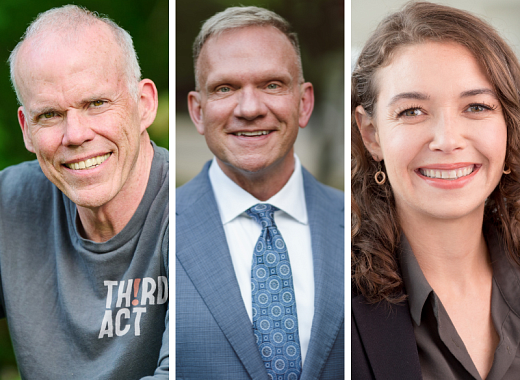
The conversation features environmental writer and activist Bill McKibben, whose decades of work have helped define how we understand the climate crisis and the opposition to addressing it. He is joined by Ricky Bradley, Executive Director of Citizens’ Climate Lobby, who brings a strategist’s perspective on how beliefs are formed, how misinformation spreads, and what it takes to build political will for climate action across ideological divides.
The program is moderated by Rebecca Hersher, correspondent on NPR’s Climate Desk, whose reporting on climate science, extreme weather, and human adaptation offers a clear-eyed view of how these debates play out in real time. Together, they unpack how denial has been organized and sustained, and consider what it will take to move beyond it.
To learn more about and register for Part 2 of Confronting Climate Change click here and for Part 3, click here.
Participants
Bill McKibben is a contributing writer to The New Yorker, and a founder of Third Act, which organizes people over the age of 60 to work on climate and racial justice. He founded the first global grassroots climate campaign, 350.org, and serves as the Schumann Distinguished Professor in Residence at Middlebury College in Vermont. In 2014 he was awarded the Right Livelihood Prize, sometimes called the ‘alternative Nobel,’ in the Swedish Parliament. He's also won the Gandhi Peace Award, and honorary degrees from 19 colleges and universities. He has written more than twenty books about the environment, including his first, The End of Nature, published in 1989; The Flag, the Cross, and the Station Wagon: A Graying American Looks Back at his Suburban Boyhood and Wonders What the Hell Happened, and his most recent book, Here Comes The Sun.
Ricky Bradley is the Executive Director of Citizens' Climate Lobby (CCL) and Citizens' Climate Education (CCE), a nationwide movement of more than 20,000 active volunteers building the political will for federal climate solutions. A strategist, organizer, and civic innovator working at the intersection of climate policy, grassroots advocacy, and human behavior, he brings a grounded, evidence-based, and deeply human perspective to one of the hardest questions in climate advocacy: why do people believe what they believe, and what does it actually take to change minds? Before becoming Executive Director, he was a local and regional organizer and built the tools and systems that help CCL's volunteers track and amplify their civic impact. He also launched Citizens' Climate University, CCL's flagship learning platform equipping everyday people with the knowledge and skills to influence federal climate policy.
Rebecca Hersher is a correspondent on NPR's Climate Desk, where she reports on climate science, weather disasters and how humans are adapting to a hotter world. Hersher was part of the NPR team that won the Kavli Science Journalism Award for the series "Beyond the Poles: The far-reaching dangers of melting ice," as well as a Peabody award and an Edward R. Murrow award for coverage of the Ebola epidemic in West Africa. Her 2019 coverage of climate-driven flash floods also won an Edward R. Murrow award, and she was part of a team that was honored with a 2020 Society of News Design award for multimedia storytelling. She was a finalist for the Daniel Schorr prize, a Pulitzer Center on Crisis Reporting fellow and an NPR Above the Fray fellow, investigating the causes of the suicide epidemic in Greenland.
Confronting Climate Change is presented with generous support from Con Edison.