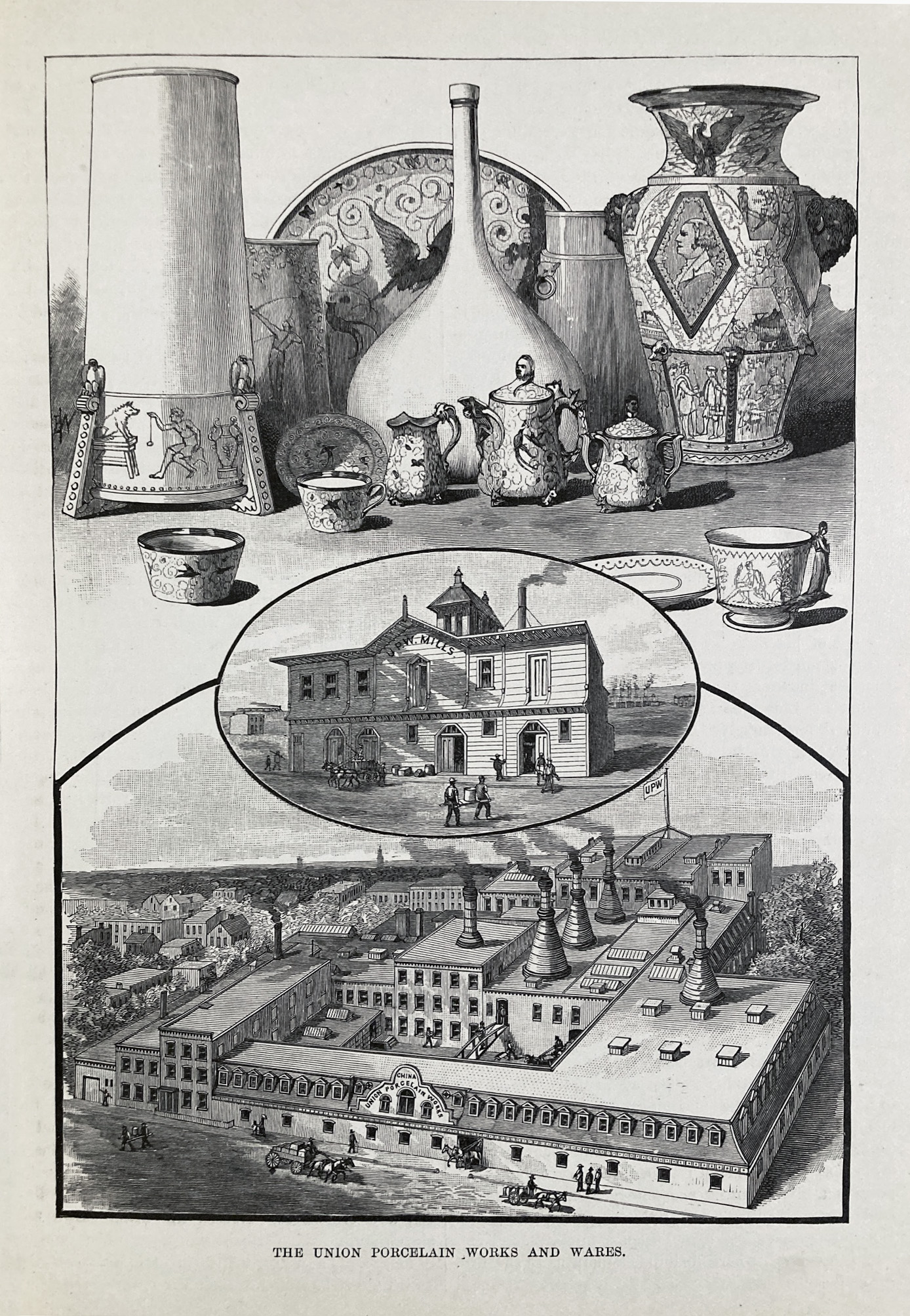
Some years ago, while researching a blog on Henry Reed Stiles, a prominent historian of Brooklyn, I was looking through the omnibus he edited with the help of many subject experts on Brooklyn history and the illustration above caught my eye. The book, published a short time before the 1898 consolidation of NYC, is very much a paean to the still independent city of Brooklyn, itself an amalgam of separate towns with their own individual character.
The illustration shows a collection of decorated chinaware, a modest wooden building - site of the firm’s beginnings, and an aerial view of the large brick factory where the decorative wares were made. I planned to explore the topic and shelved it for a later date. Recently, in a walk through the Brooklyn Museum, I came upon the most famous piece produced by that factory, the Century Vase, featured above on the far right. Chasing down the story of the vase, I learned that Brooklyn was America’s first porcelain manufacturing center.
Pottery has a long history in all of the Americas, and the young United States was active in creating ceramic products, but porcelain, requiring a difficult process with specialized materials, was only known through imports until the 1850s.
Pottery Hill: the birth of Greenpoint’s ceramics industry
In the early 19th century Greenpoint was a burgeoning industrial section of Brooklyn, its growth spurred by a deep draft beach favorable to goods transport and shipbuilding.
Soft-paste vs. Hard-paste true porcelain
In the 1840s we see competing pottery businesses appear in Greenpoint, in an area that became known as Pottery Beach or Pottery Hill. At this time English potteries were producing soft-paste porcelain, and the new industry in the US followed this model. Soft-paste has the advantage of firing at lower temperatures and allows for a wide range of colors in decorative finishes, but results in a more fragile product. Hard-paste, or true porcelain, is composed of finer materials that are harder to source, requires higher temperatures, has a more restricted color palette, and results in a smoother finish and a harder, thinner and more durable product. This process, originating from China - hence the general term china for tableware, was well established in France and Germany by the time attempts were made to achieve it in the US. Early potteries in Greenpoint, and in other states, made essays at true porcelain manufacture, but none enjoyed a sustained success until the Union Porcelain Works. [reference: Brief history of the Union Porcelain Works, https://reference.insulators.info/publications/view/?id=12985, accessed 2025-12-17]
The potteries in this area, as they evolved through different owners and names, are somewhat difficult to place. I will talk briefly about some of them and then focus on Union Porcelain Works, which became the most prominent and enjoyed a lot of reporting in the newspapers.
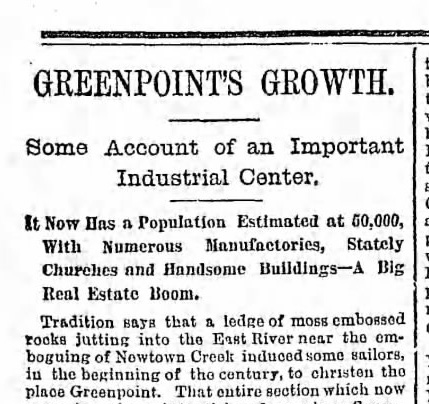
The earliest evidence I found in the archive of the constellation of Pottery Hill businesses (although perhaps not the earliest in the neighborhood) was a retrospective article looking back almost 30 years to an establishment started by Charles Cartledge [sic] [Cartlidge] in 1847, which appars to have operated for about a decade. Cartlidge, although he was unable to make a go of the company, must have had considerable resources because an article from 1873 on Greenpoint history digresses from its manufacturing subject to describe a party given by Cartlidge at his private residence for Greenpoint society where artisans in his employ, the Boch brothers, played music for the guests, and thereby met future wives among the well-to-do.
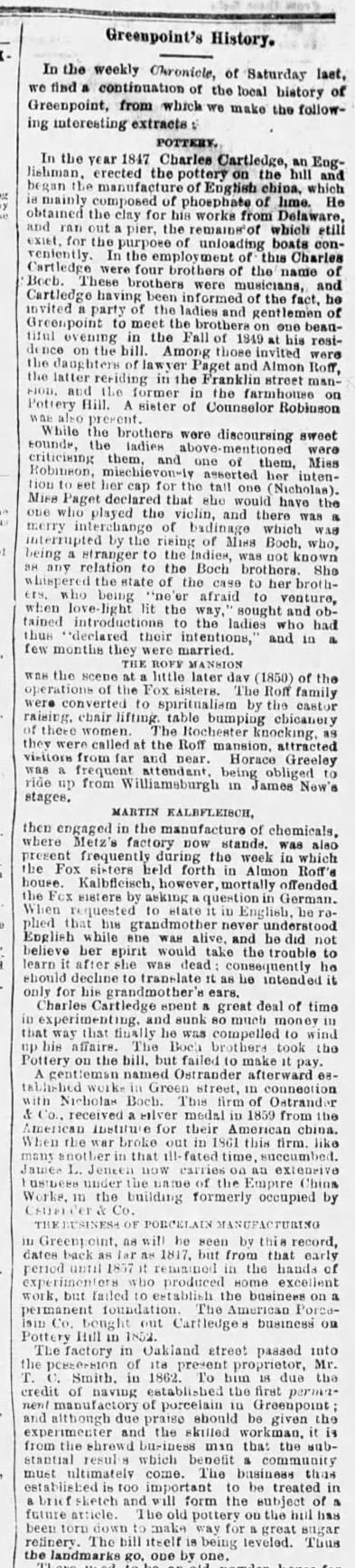
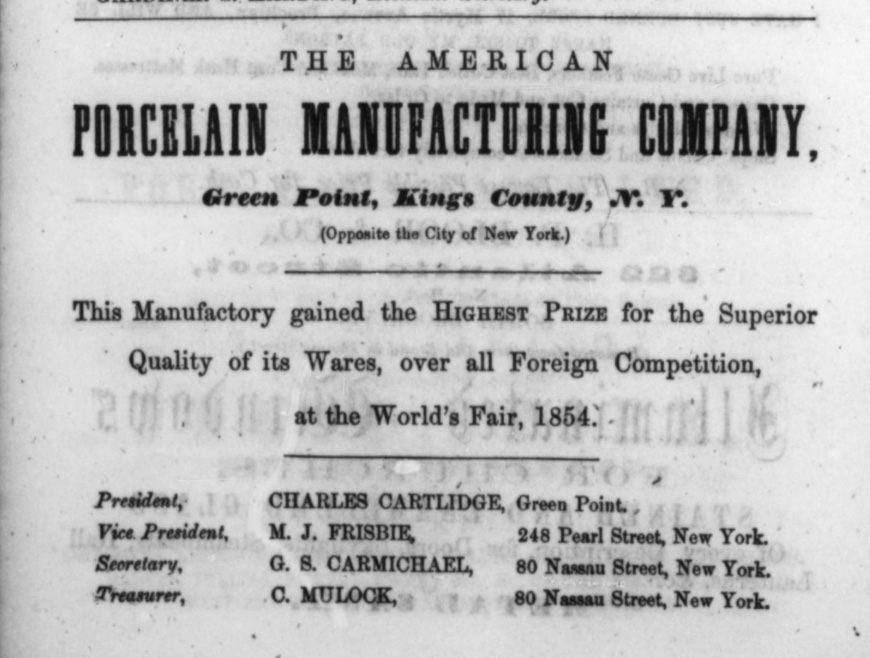
The above article reports that American Porcelain Manufacturing (APM) bought out Cartlidge in 1852, though this advertisement in the 1856 directory lists Cartlidge as president indicating he had stayed on as a principle. Later that year a notice indicates the company was in difficulties and its assets were put up for sale. However, another add the following year, 1857, indicates it perisisted, although without Cartlidge in the top officers.
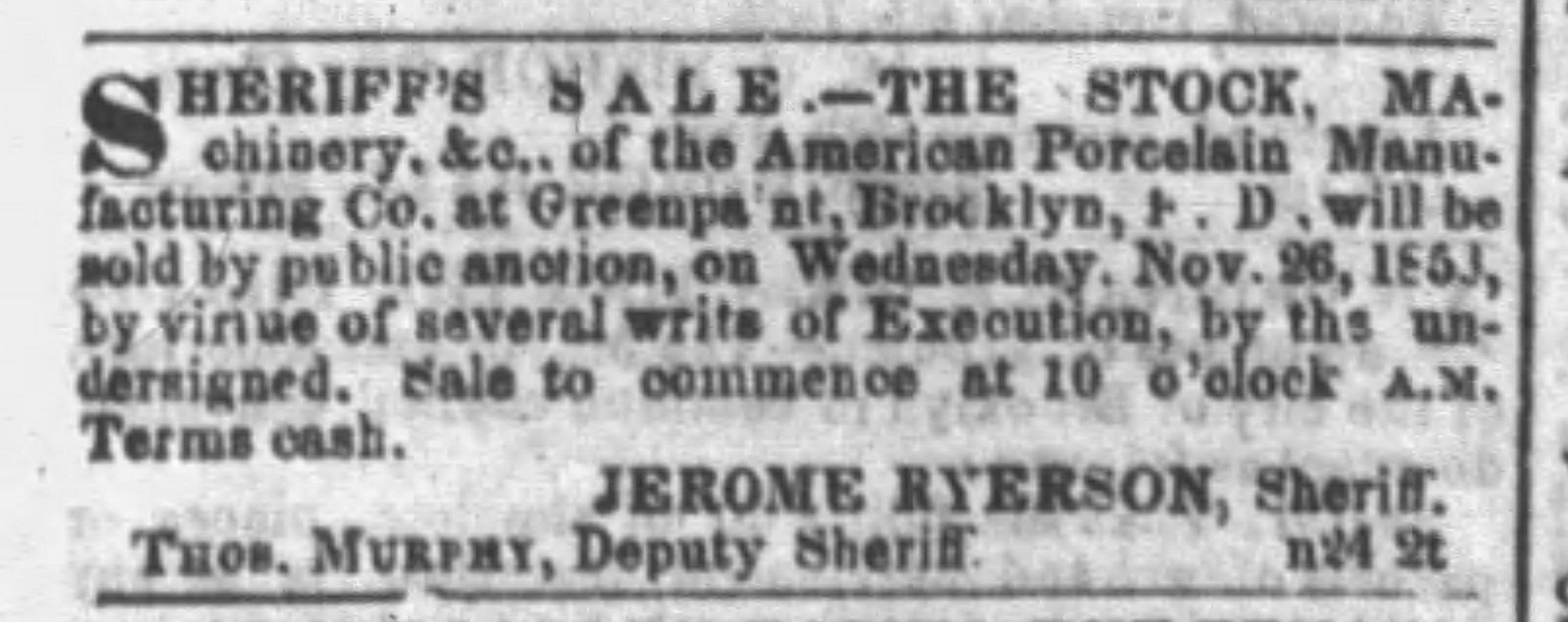
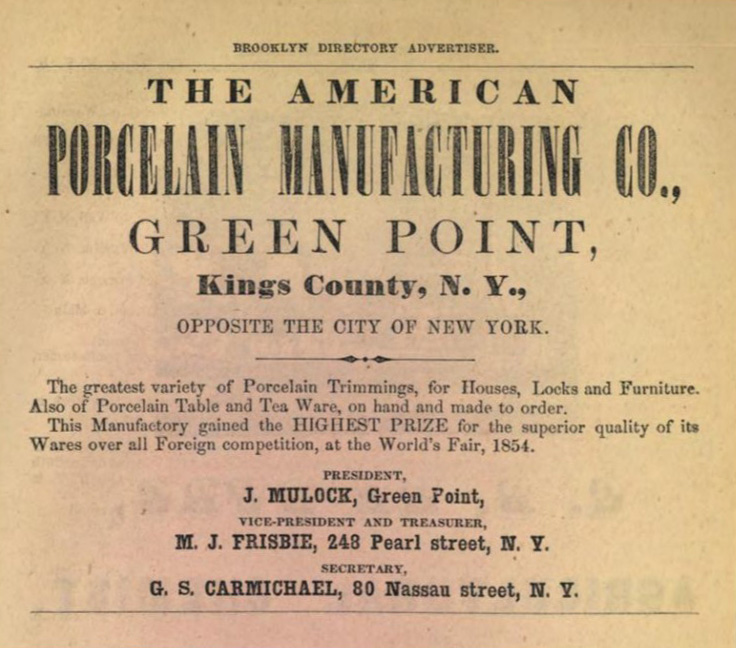
Newspaper accounts indicate at some point its operations passed to the musical family that had worked for Cartlidge who formed a firm called William Boch & Brothers.
As early as 1850 we can see a directory entry for 'William Boch, porcelain manufacturer,' and advertisements for William Boch & Brothers start to appear in the directories in 1853. By 1856 William Boch & Brothers are working from 300 Eckford Street.

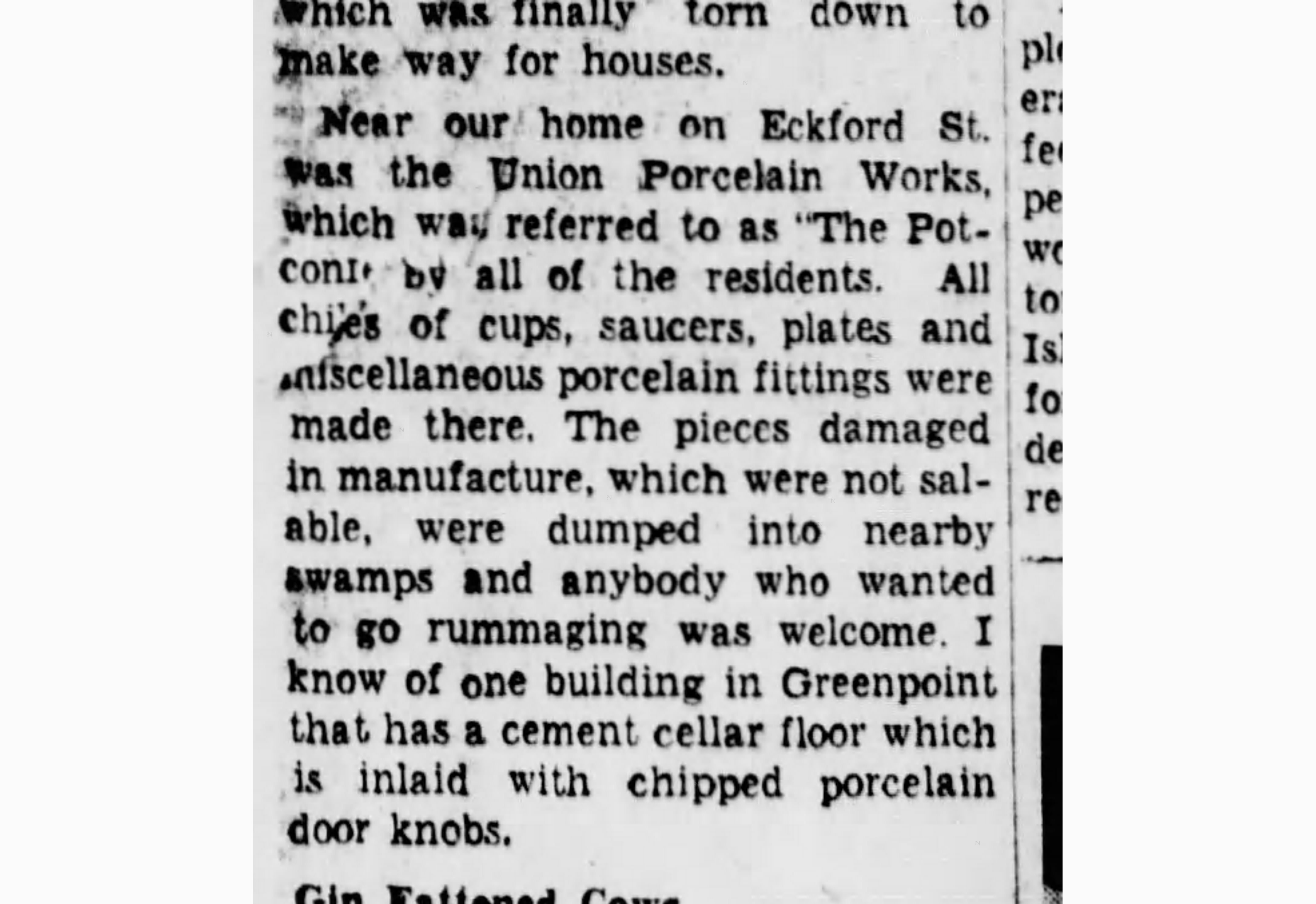
At this time much of the soft-paste porcelain industry was devoted to producing household trimmings like doorknobs, sink taps, clock faces, and industrial fixtures like insulator caps for electrical devices. An article from 1940 recounts the ubuquitous waste that remained long after these businesses departed.
“The pieces damaged in manufacture, which were not salable, were dumped into nearby swamps and anybody who wanted to go rummaging was welcome. I know of one building in Greenpoint that has a cement cellar floor which is inlaid with chipped porcelain door knobs.”
Porcelain fragments are the most benign leftovers one could find in Greenpoint but a glance at the number of industrial sites - ironworks, glassworks, sawmills and coal, to name a few - makes it very clear why Greenpoint struggles with pollution to this day.
One brother branches out
One of the Boch brothers, Nicholas, left Boch and Bros. to join another pottery firm, Ostrander & Co.
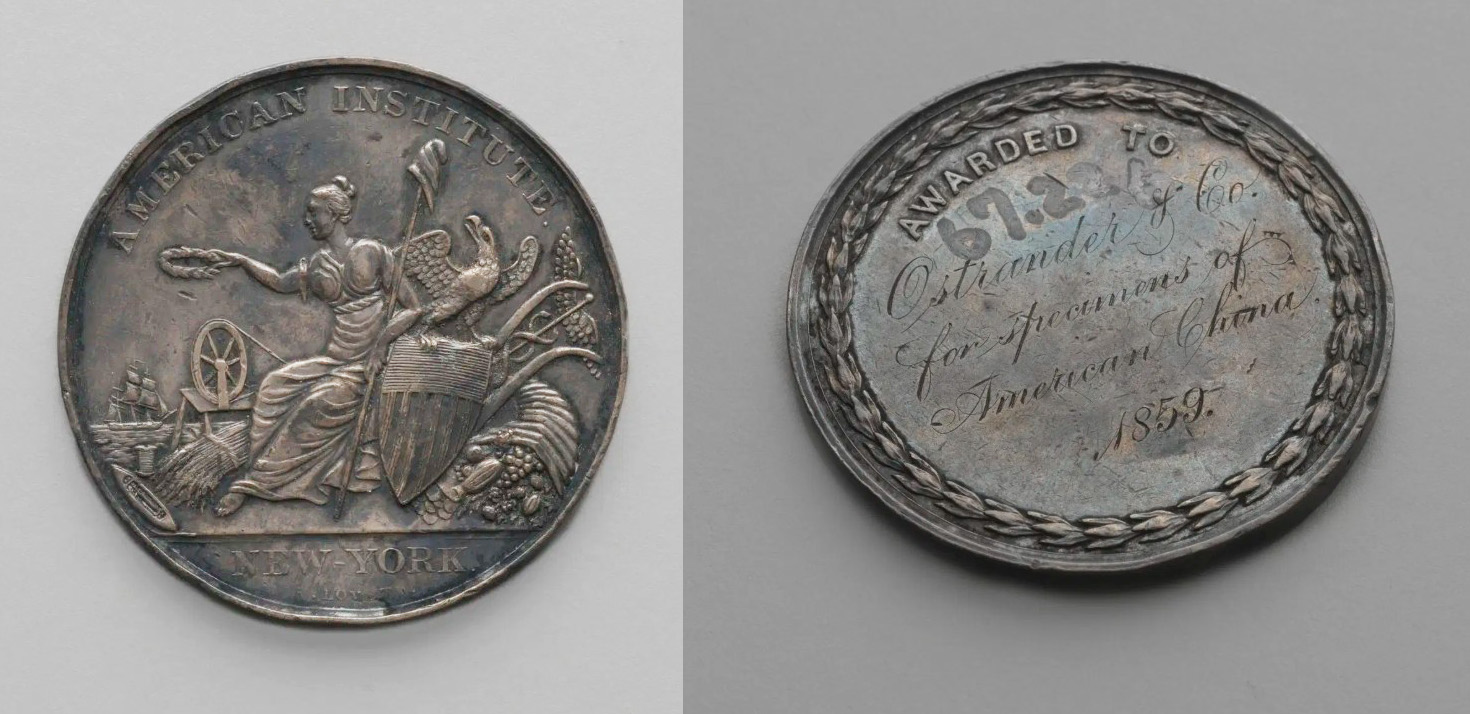
Despite producing work that won awards, the economic disruption of the Civil War led to Ostrander’s closure and purchase by James L. Jensen who renamed it Empire China Works.
Boch & Brothers becomes Union Porcelain Works
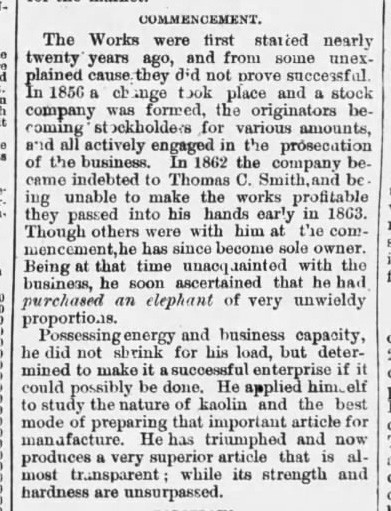
The Civil War disrupted the economy of other ceramic concerns. Boch Brothers was in business as a stock company owned by the employees producing soft paste porcelain fixtures and decorative wares for about a decade until its forfeiture to its majority stockholder Thomas C. Smith, in 1863.
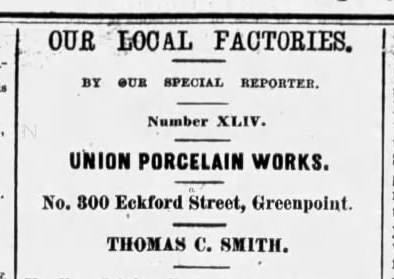
being at that time unacquainted with the business, [Smith] soon ascertained that he had purchased an elephant of very unwieldy proportions.
Fine materials and mass production
Smith, an architect, educated himself in the ceramics industry and, through experimentation and capital investment, engineered the production of true porcelain at an industrial scale. Not only did this involve sourcing more refined materials and bringing kilns to higher temperatures, but streamlining the forming process to produce items in greater numbers to profit by economies of scale.
Smaller fixtures, like doorknobs could now be made by pouring liquid material into molds (casting.) Vessels were still thrown on a potter’s wheel, but those were powered by steam rather than a foot treadle, and much of the trimming could be done by lathes rather than by hand. These changes may have represented a loss of refinement, but allowed cheaper goods to reach more consumers, and enabled the factory to remain profitable for many decades. Under his ownership the company became Union Porcelain Works (UPW.)
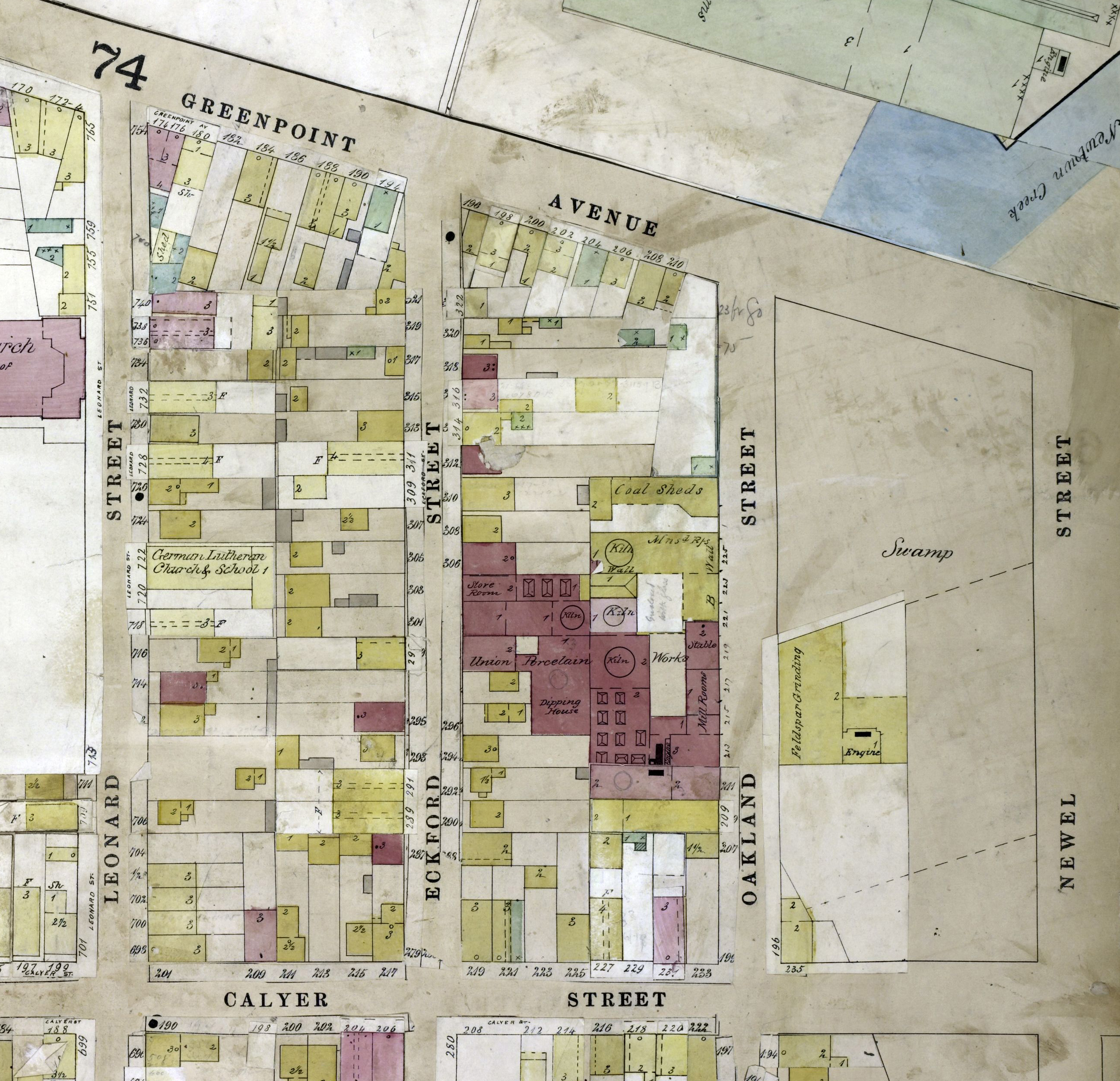
In this map of 1868, we can see the extent of the factory buildings at 300 Eckford Street, and the different areas the goods passed through on their way through the production process. We can see across Oakland Street a building labeled: Feldspar Grinding, which must have been an extension of the factory since feldspar is a crucial ingredient in the production of porcelain.
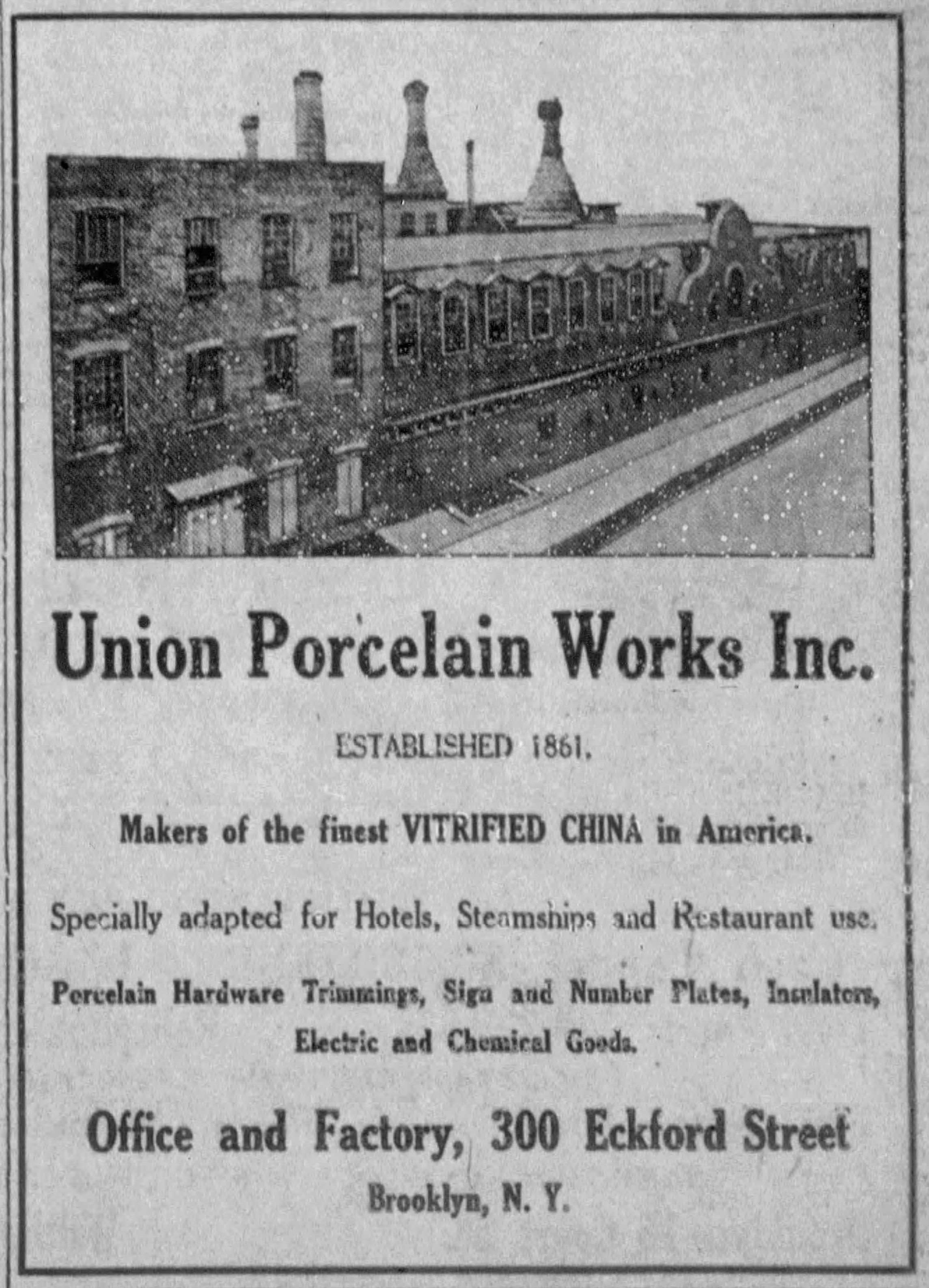
This photograph, taken almost fifty years later, shows the factory’s imposing façade and huge kilns.
The Century Vase
The company thrived under Smith's ownership and in 1876, for the commemoration of the nation’s independence, sent an impressive set of wares to the Philadelphia Centennial Exhibition. The head of the creative department at UPW, the German sculptor Karl L.H. Muller, known for his fanciful and imaginative designs, created the Century Vase for the Centennial, and it became a signature piece for the company.
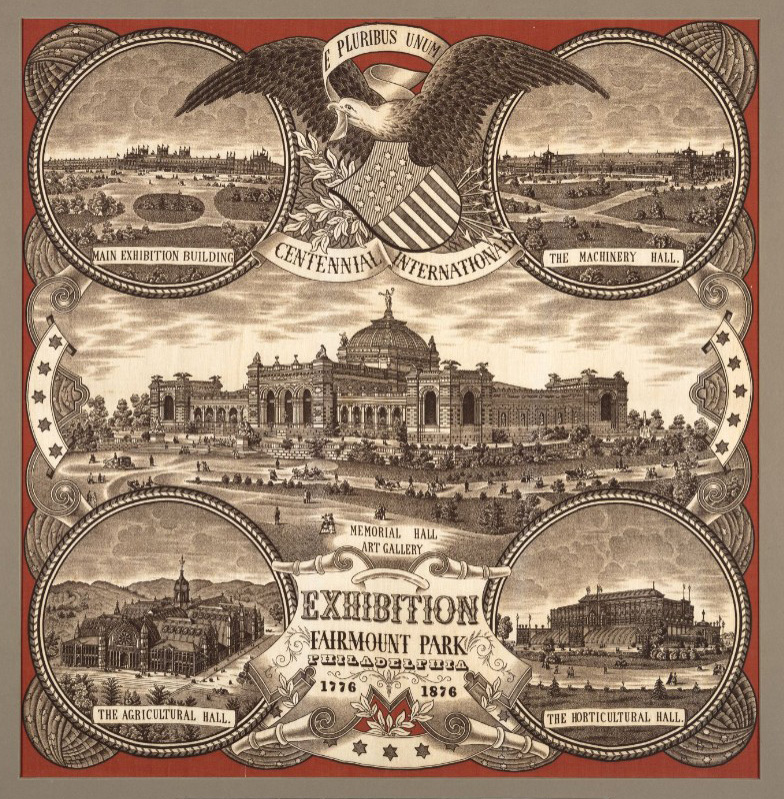
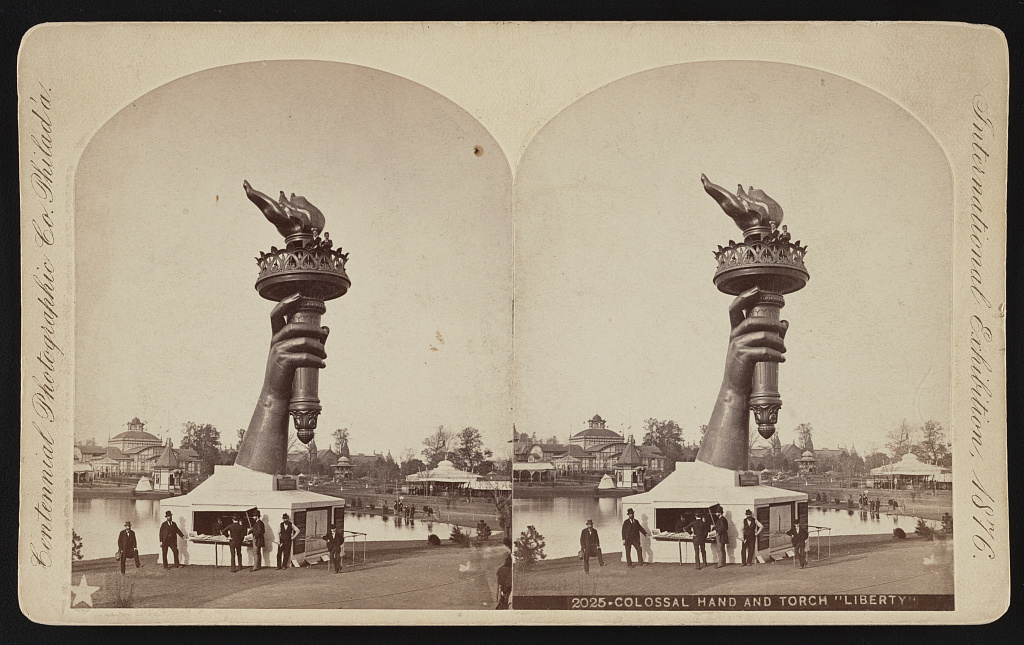
Securing a place for one’s products at the centenary must have been a coup, providing valuable publicity and the imprimatur of elegance and quality. One venerable artwork displayed, in part, at the exhibition was the upright arm and torch of the Statue of Liberty by Frédéric Auguste Bartholdi - a sneak preview of the monument in progress.
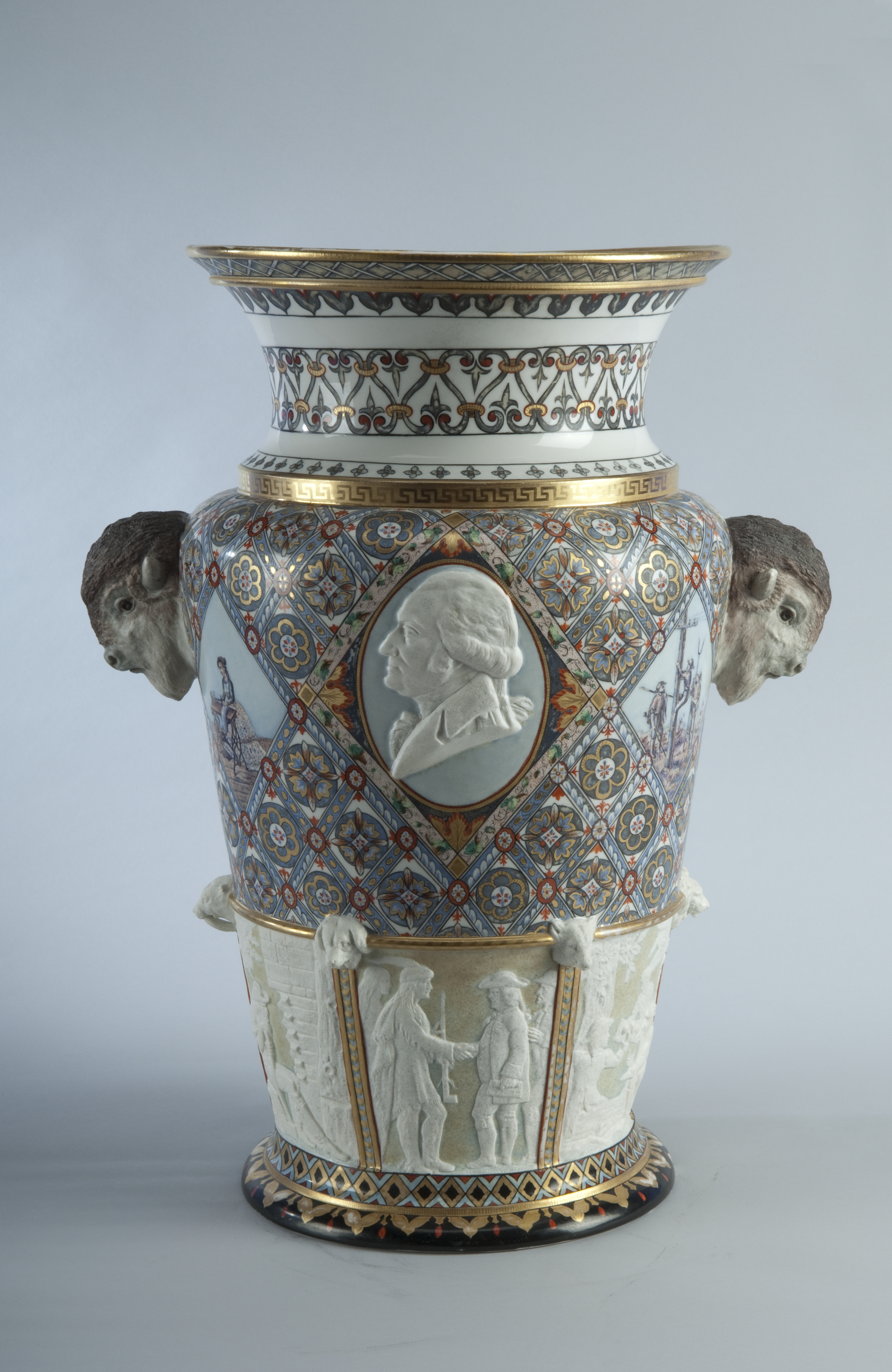
The Century Vase, impetus for this article, was a work produced in many multiples, including half sized versions, with a variety of decorative finishes. Versions can now be found in a number of museums, including the Brooklyn Museum, the Smithsonian, and the Metropolitan Museum. The Century Vase in the Brooklyn Museum, which matches the illustration in Stiles’ book, is an exuberant paen to the nation’s history, its imperial project and its growing industries. The Brooklyn Museum record describes the decorative program of the vase:
Object Label - Created for the U.S. Centennial Exhibition in Philadelphia in 1876, this monumental vase was designed by a German-born sculptor and made by a premier American porcelain manufacturer … Its symbolic images include a profile portrait of George Washington and bison-head handles, while trophy heads around the midband represent other native animals such as the walrus and ram. Scenes from the nation’s past are featured in sculptural relief around the base, while above, painted vignettes devoted to examples of American invention and progress convey the sweep of history.
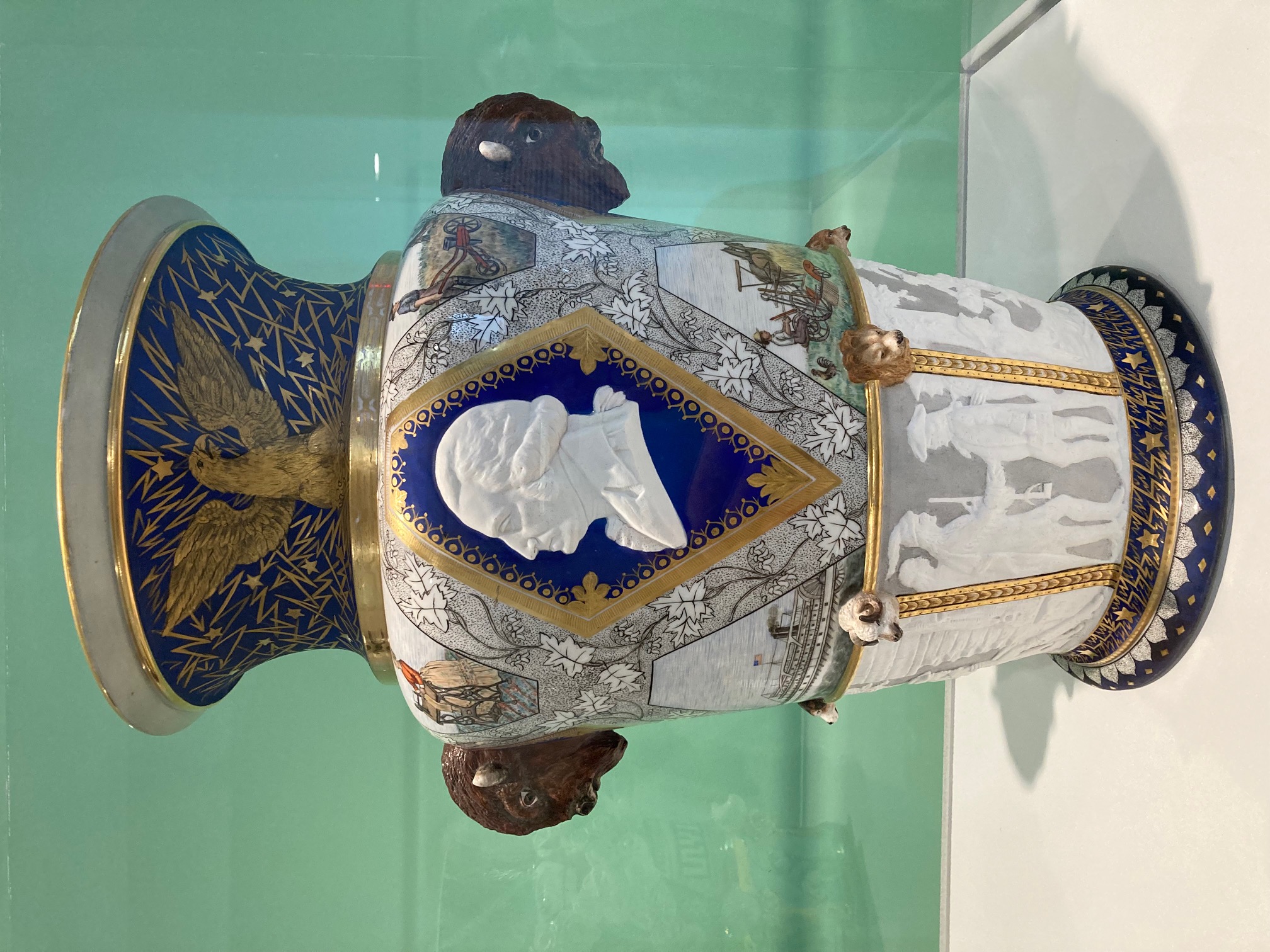
The vase stands 22 inches high, its half-pint versions at 12 inches. I’m especially fond of this example for the lightning bolts radiating around the eagle, referencing the still wonderous force of electricity. There is also a sly advertisement for the porcelain works itself in a vignette, seen in pride of place on the top level, of a workman at a work table using a machine lathe on a ceramic bowl surrounded by dozens of other clay blanks waiting to be worked. Just above his head, we can see the firm’s logo - an eagle with an arabesque in its beak.
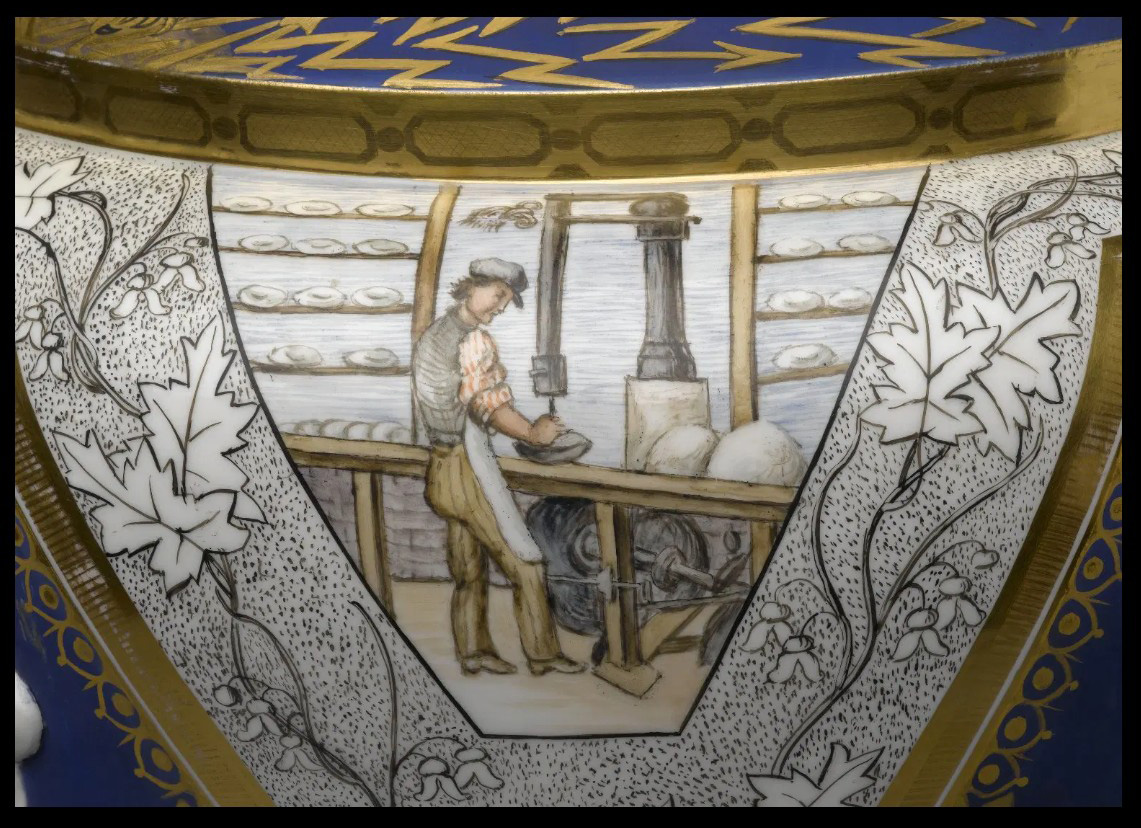
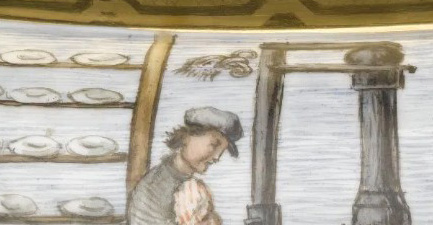
The company logo in this vignette is hard to decipher, but this advertisement shows it clearly.
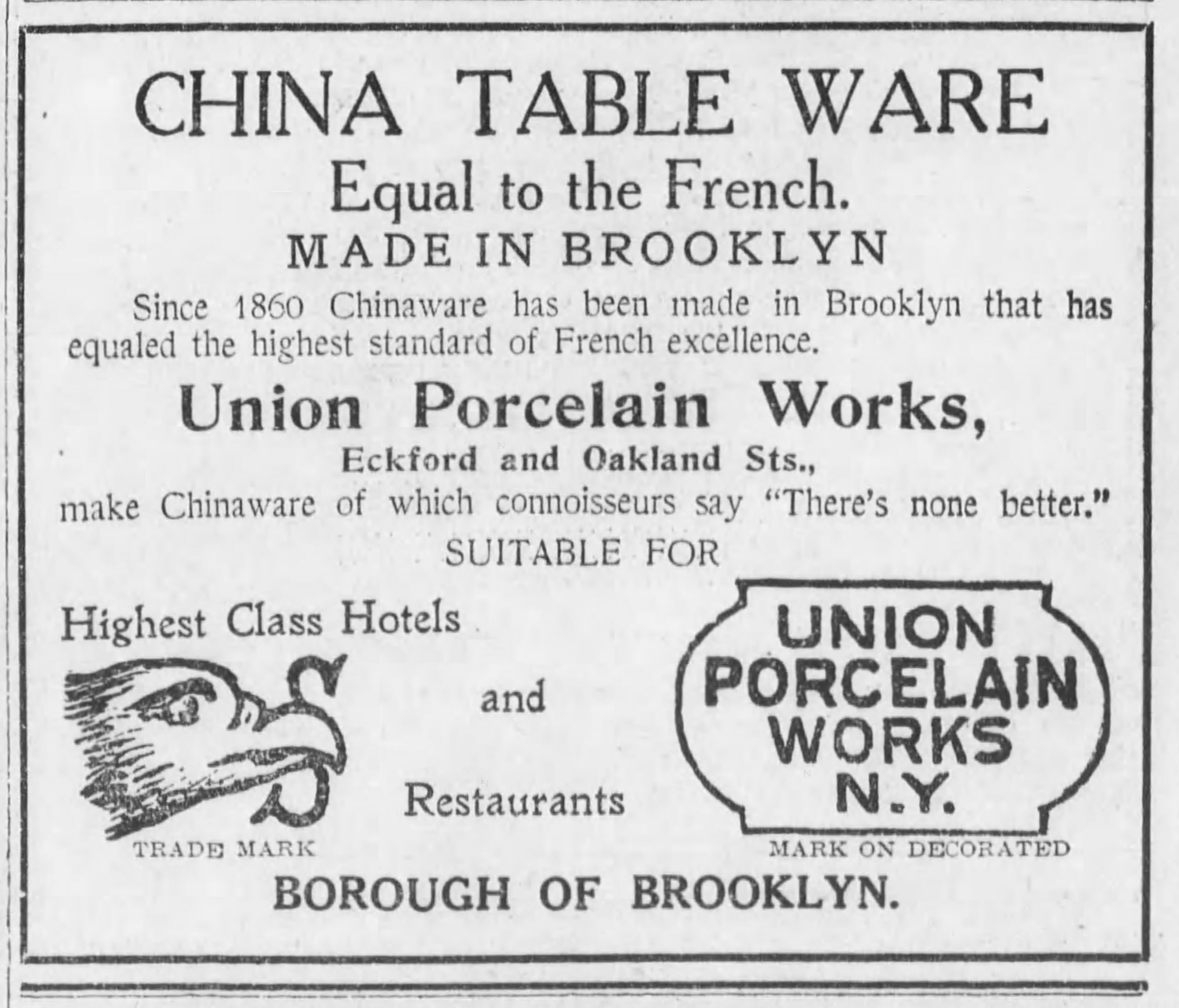
In Michael Padwee's blog, Nineteenth Century Brooklyn Potteries [accessed 2025-12-18] he writes:
According to Lehner's book on US marks on pottery and porcelain, "The representation of an eagle's head with the letter S in its beak was filed for registration on May 4, 1877, by Thomas Smith and Sons. The S evidently stands for Smith."
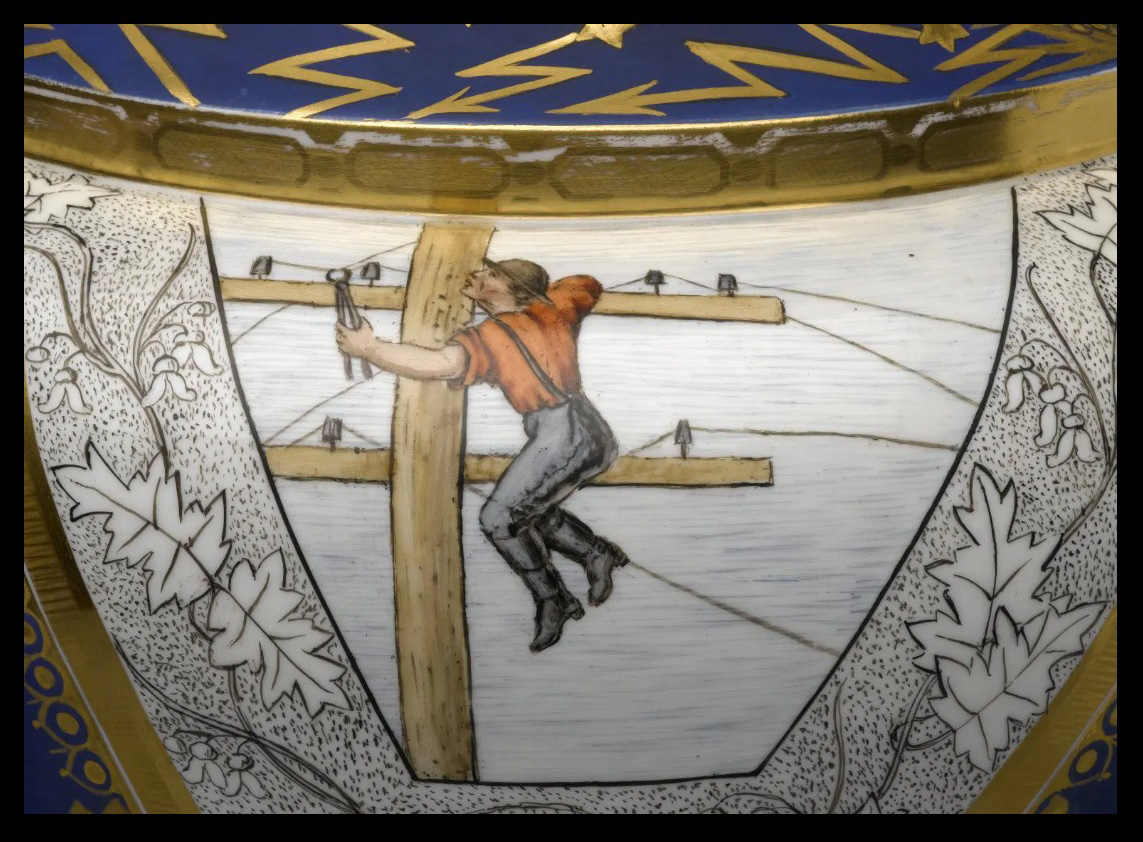
Another vignette on the vase serves as a second artful nod to the company’s products. It shows a man working on telegraph poles covered with conical porcelain insulators capping the wires.
The Smithsonian version, of the same large size, has a different decorative program, fewer vignettes of national industry, and no gold eagle surrounded by lightning bolts.
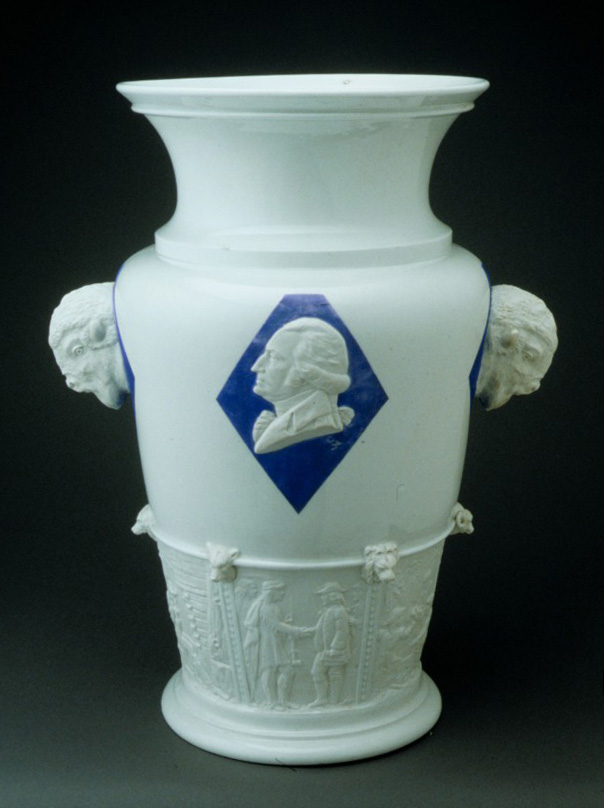
And on the unfinished Metropolitan Century Vase, almost devoid of decoration, we can see the form unobscured.
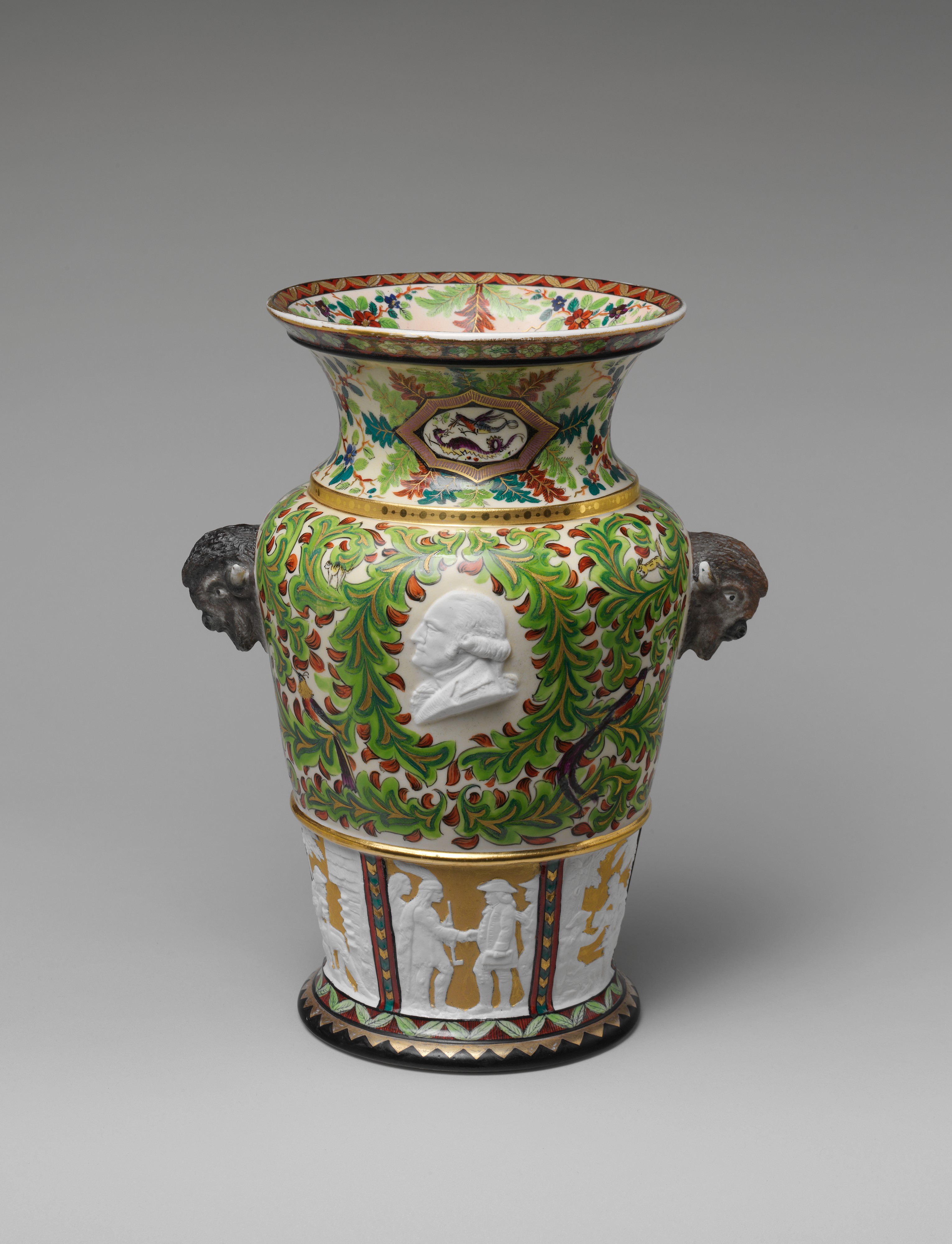
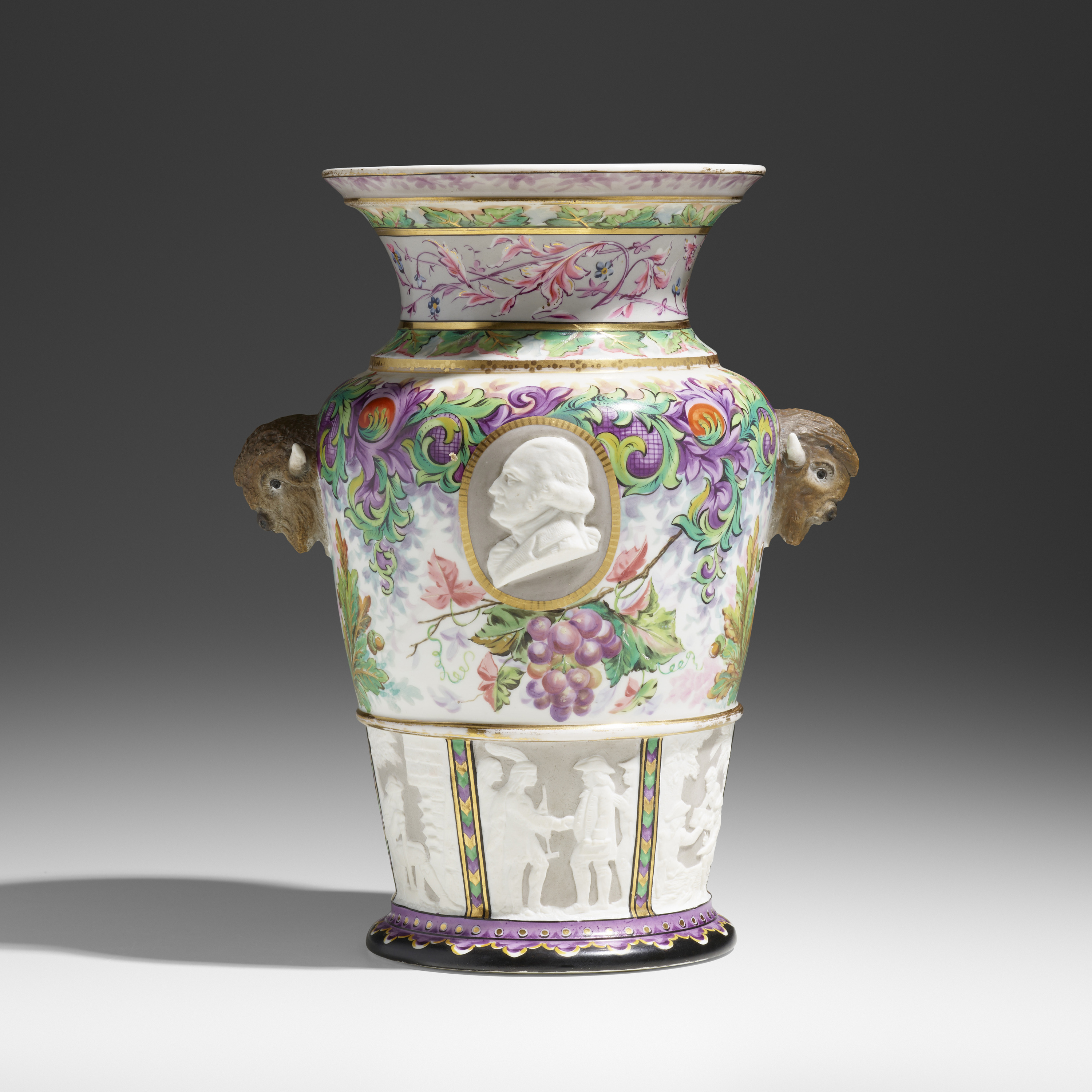
The smaller 12-inch examples of the design vase appear to be more casually and playfully decorated, like this example from the Metropolitan Museum covered with leaves, and another with flowers.
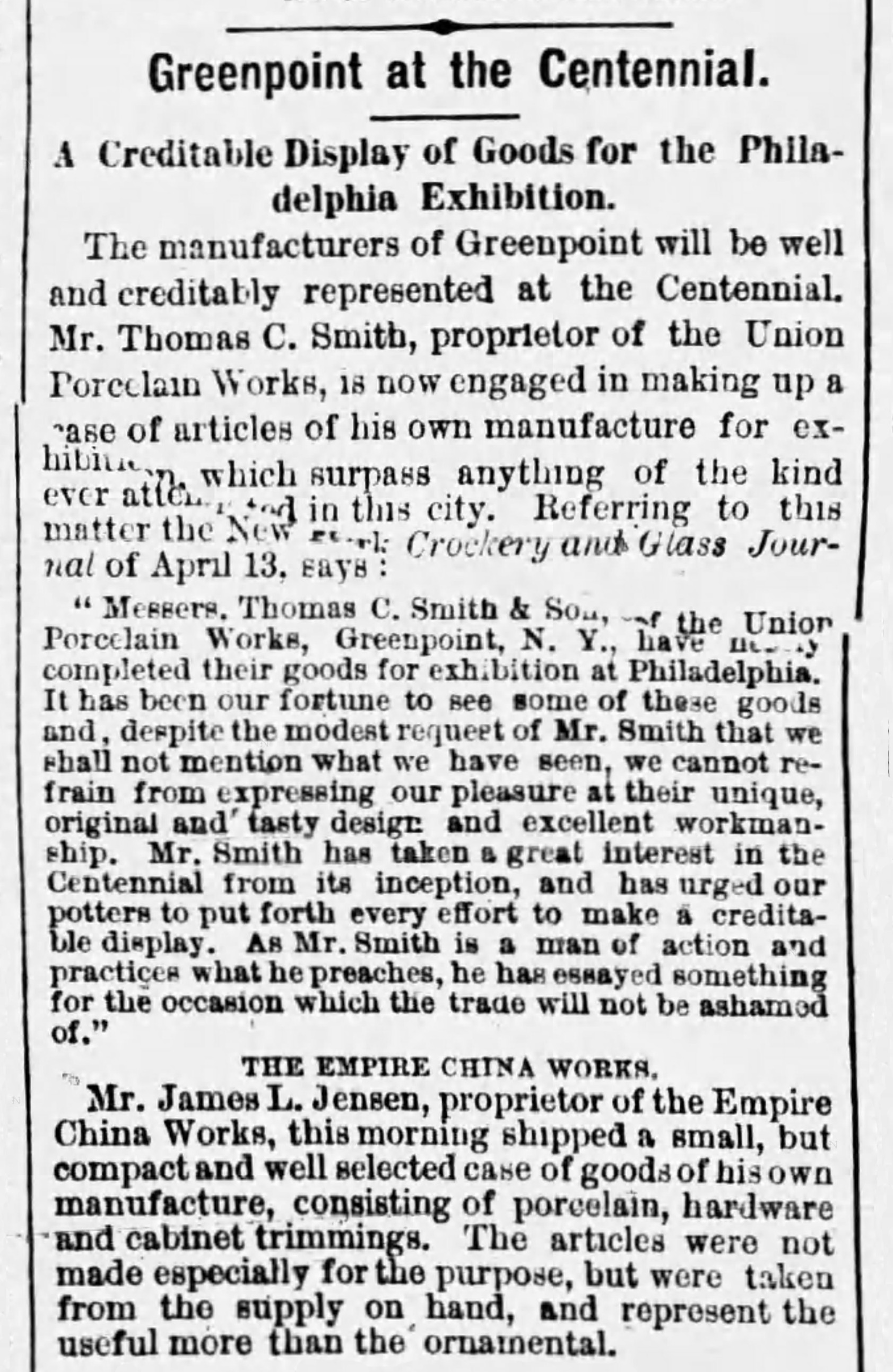
We can see that the Greenpoint potteries differed in their specializations from a Brooklyn Daily Times report covering the 1876 Philadelphia exhibition:
... we cannot refrain from expressing our pleasure at [the Union Porcelain Works goods’] unique, original and tasty design ...
in contrast to:
Empire China Works’ … articles … not made especially for the purpose, but were taken from the supply on hand, and represent the useful more than the ornamental.
Artisans in the various firms of this jostling ceramics trade expressed their competitive spirit in baseball matches.
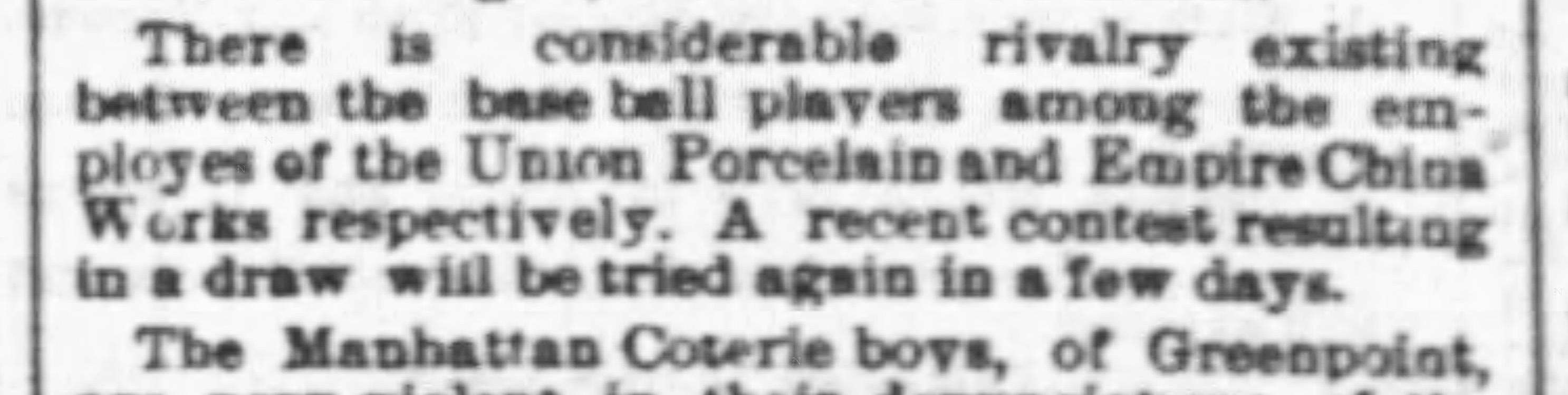
There is considerable rivalry existing between the base ball players among the employees of the Union Porcelain and Empire China Works respectively. A recent contest resulting in a draw will be tried again in a few days.
1880 Census falls short
The Union Porcelain Works’ considerable pride in its products resulted in its being left out of the 1880 census. The editor responsible for section XXI: Porcelain, Pottery, and Fictile Arts in Stiles, 1884, p.761, writes:
In no department of Brooklyn industry, have the officers of the Census of 1880 been guilty of greater or more deliberate injustice, than in the treatment of our porcelain manufactures.
The office of the census had wanted to count the factory
either under the head of "Earthen and Stone ware," with no separate designation, or under the head of " Brick and Tile," in the same way; but as a separate title, "Porcelain," never.
Union Porcelain Works refused to be counted under what they considered a misleading category and so they were omitted from the count. It makes sense that the Census wanted to constrain the number of granular categories in its statistics, but the editor here was clearly miffed by the decision. An interesting insight into the editorializing and advocacy, and perhaps the corresponding lacunae, in Stiles’ useful historical survey.
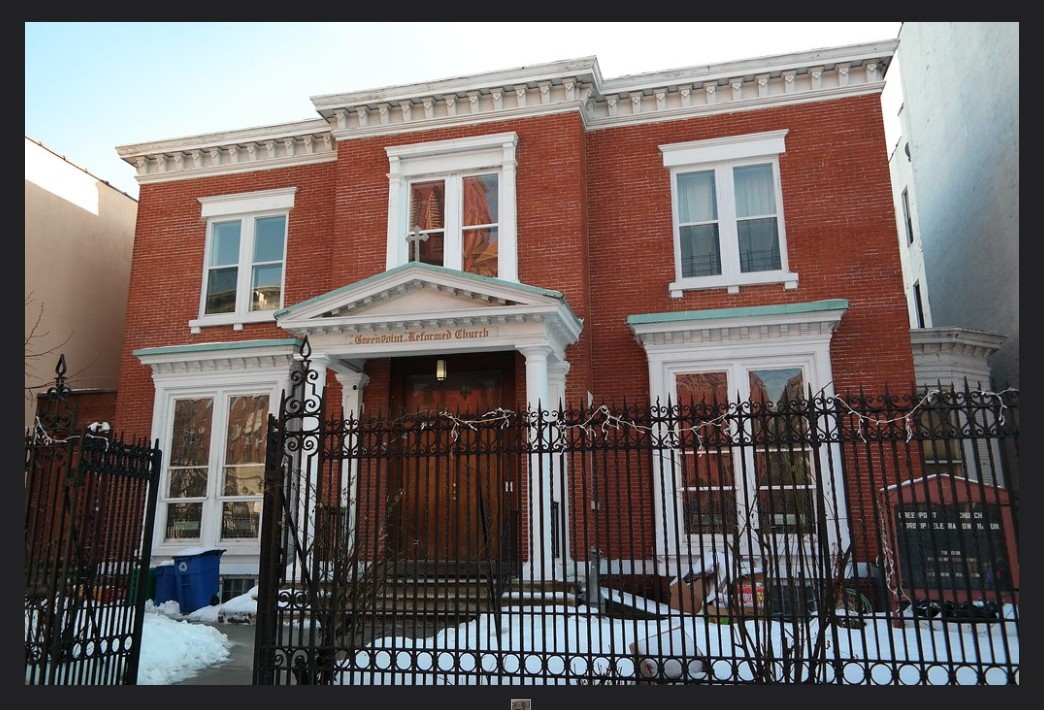
Smith and the factory thrived in the early years of the 20th century. He built a handsome brick home surrounded by greenhouses which was admired in his time and still stands at 140 Milton Street, now the Greenpoint Reformed Church.
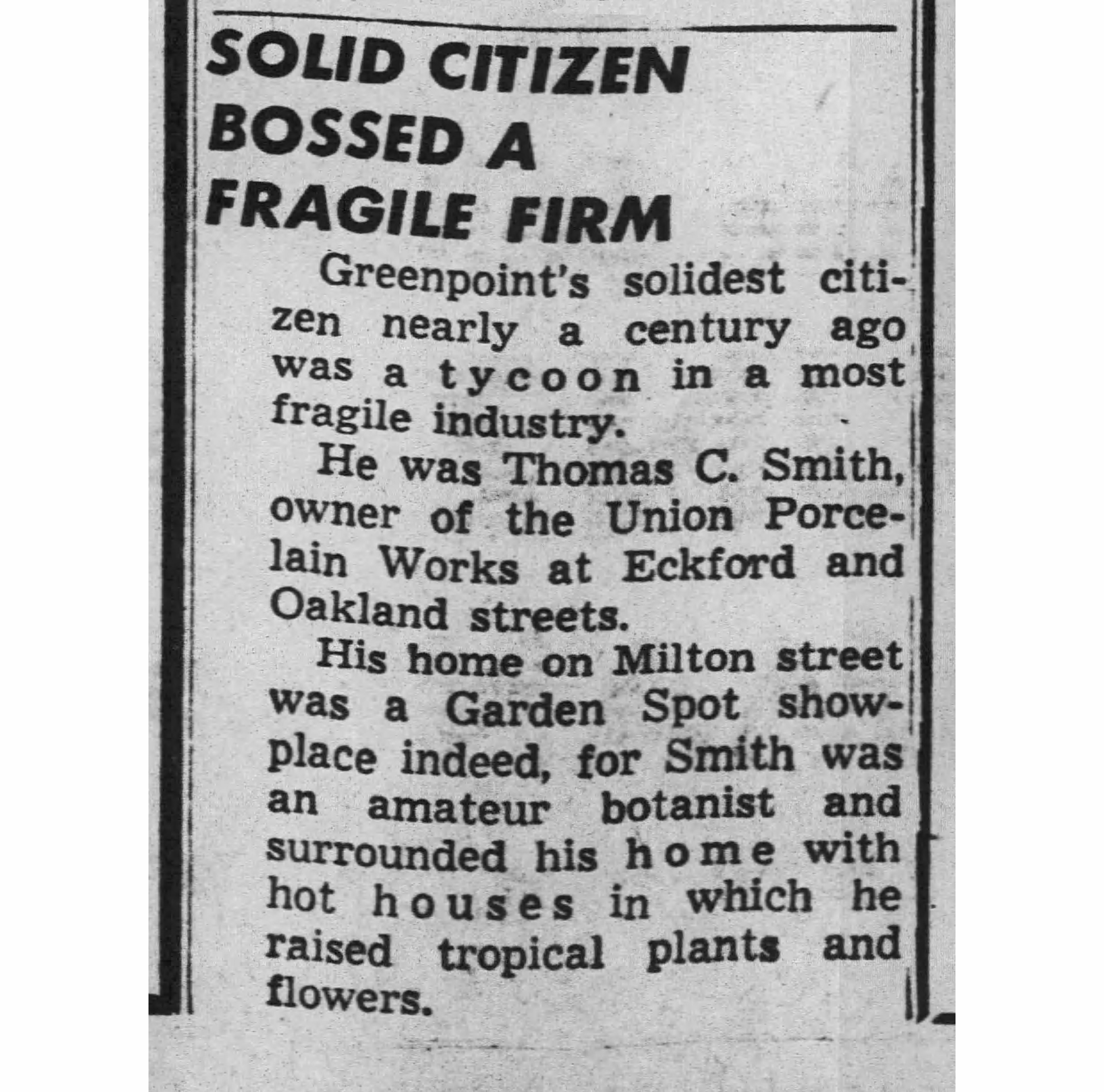
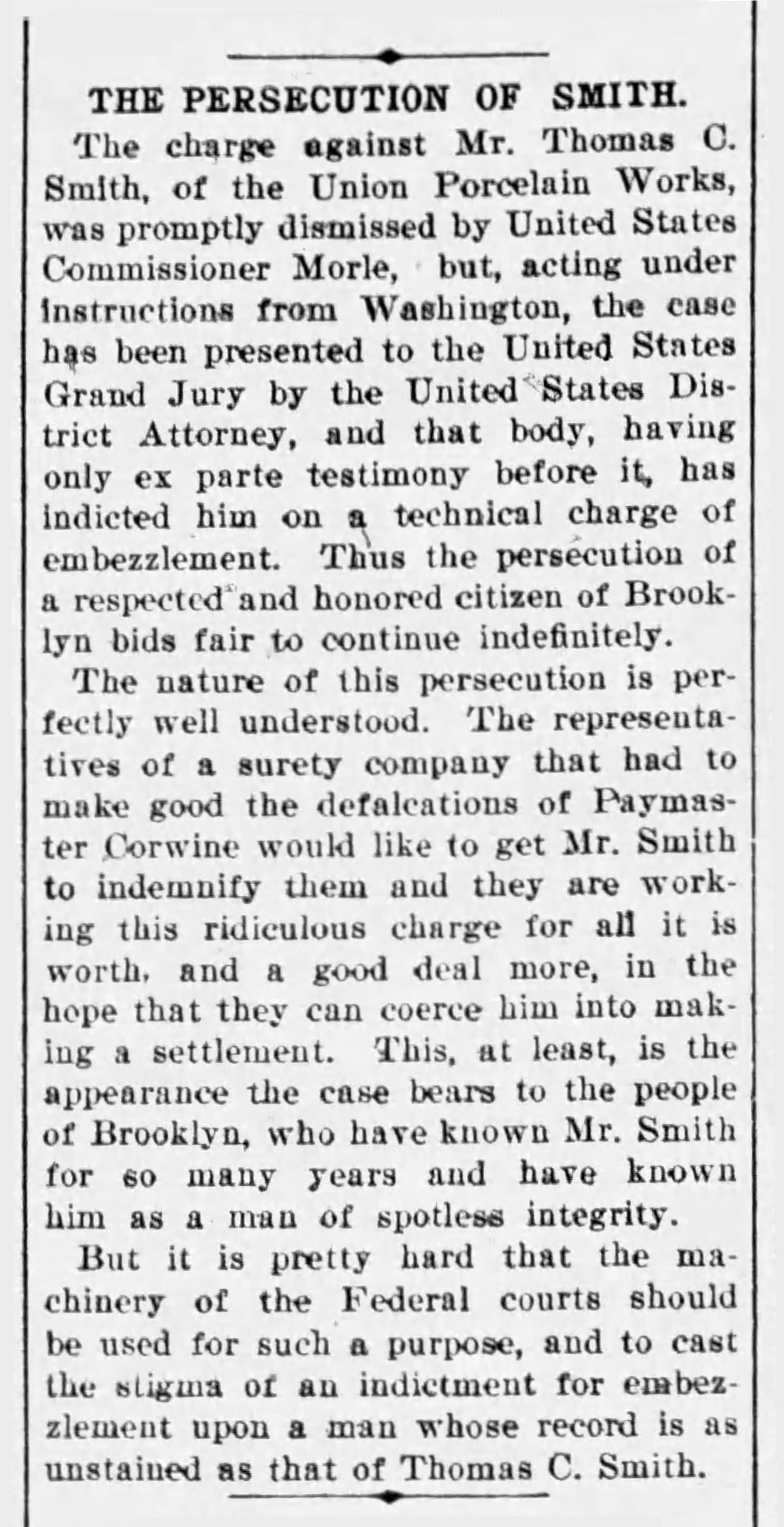
However, the final years of the Union Porcelain Works were not without difficulties. In 1897 Thomas C. Smith stood indicted on a technical charge of embezzlement, although he was fiercely defended in a Brooklyn Daily Times editorial that blames the malfeasance on John Corwine, Smith’s son-in-law. T.C. Smith was acquitted of that charge.
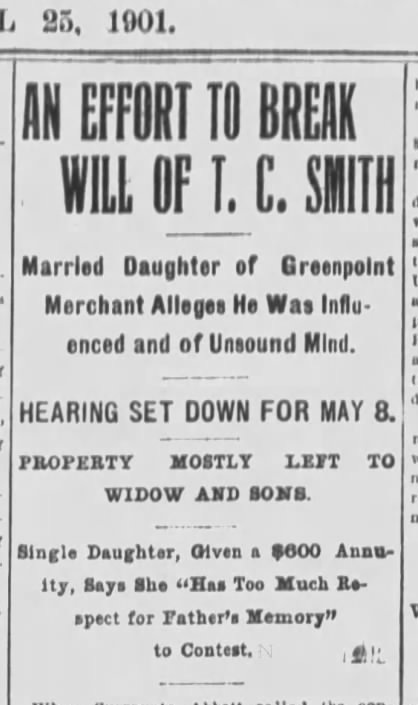
After the death of T.C. Smith in 1901, Smith’s daughter Ella H. Corwine, wife of John Corwine, learned she had been left out of her father’s will and contested it, claiming undue influence by her siblings. That case was resolved with an adjustment and discontinued and T.C. Smith’s eldest son Charles H.L. Smith - who had been working with his father - became proprietor of the factory.
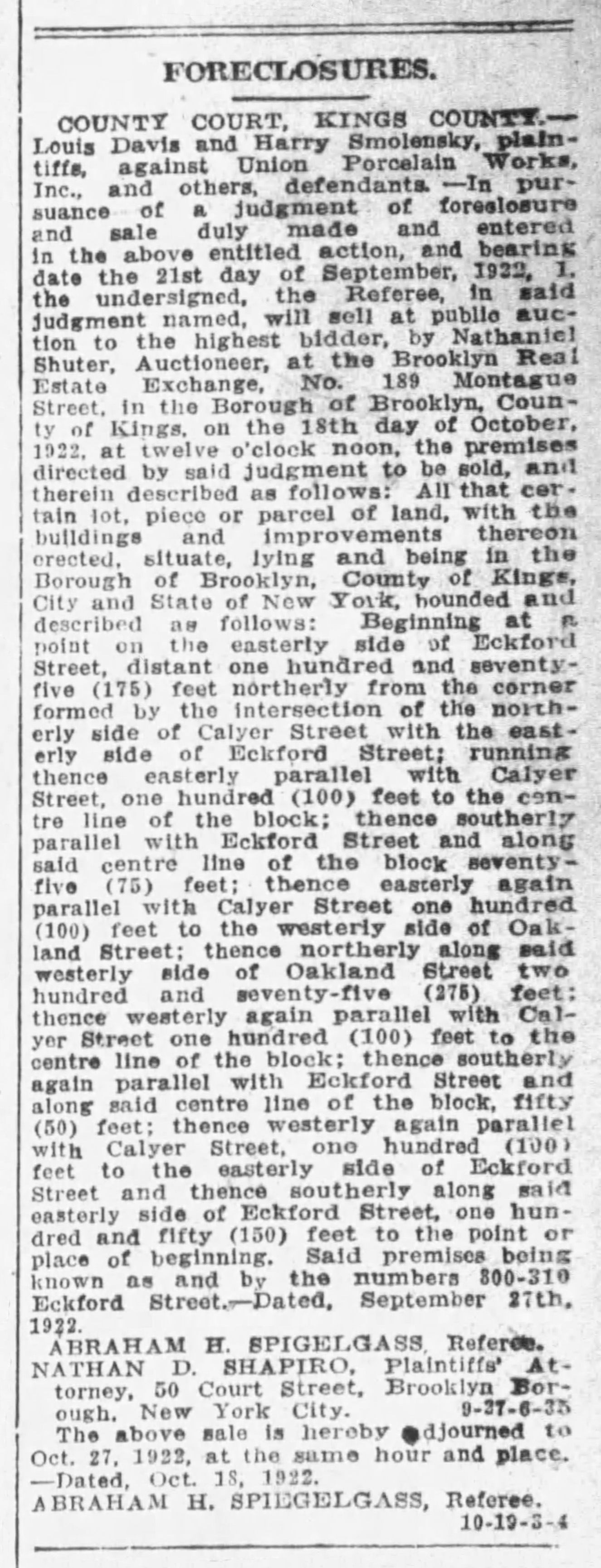
The firm continued until its foreclosure and sale of the 300 Eckford property in 1922.
And now we return to the present day and my original sighting of the Century Vase. When I happened upon the piece in the Brooklyn Museum it was displayed alongside the work of Robert Lugo in contemporary response.
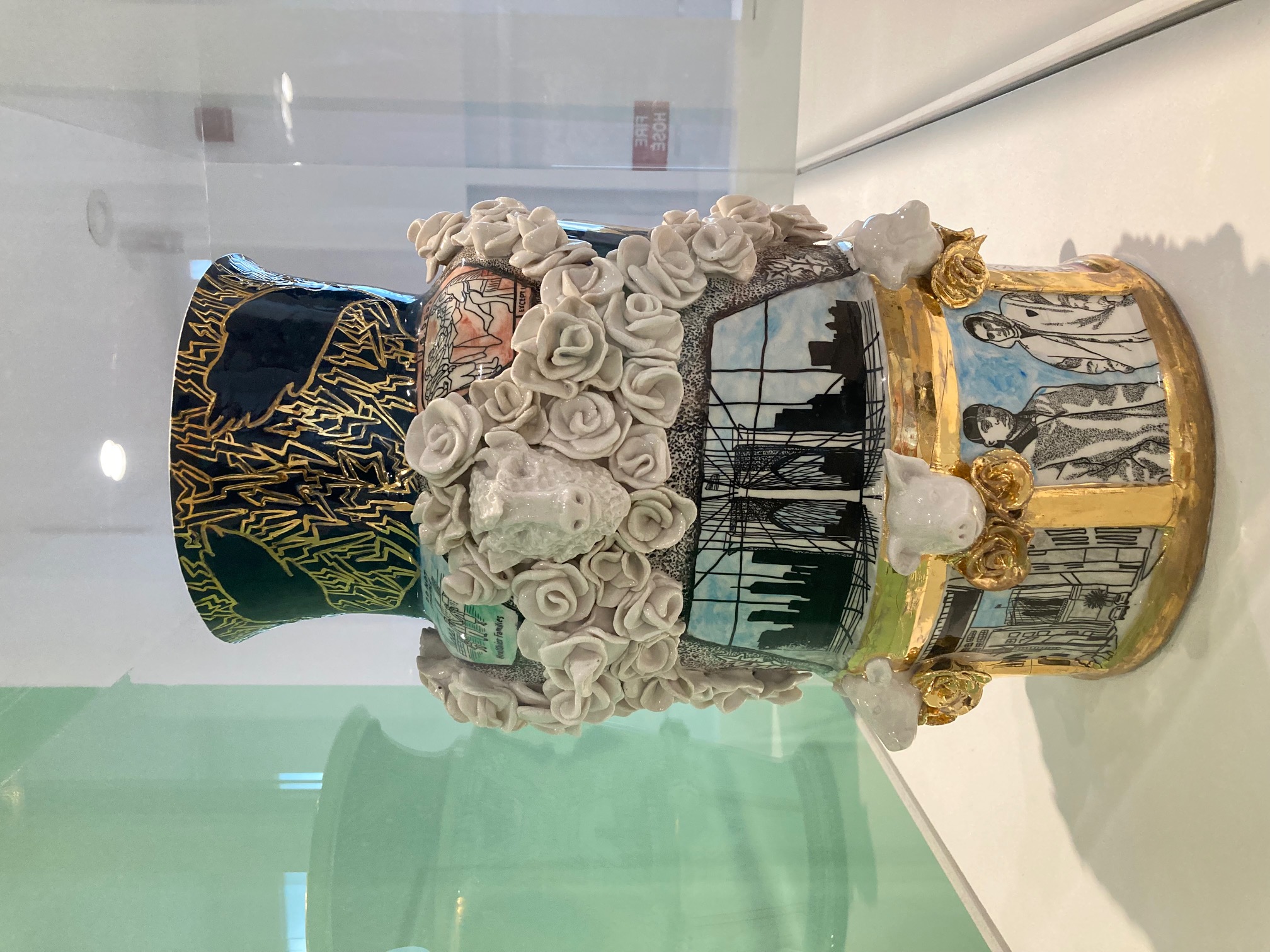
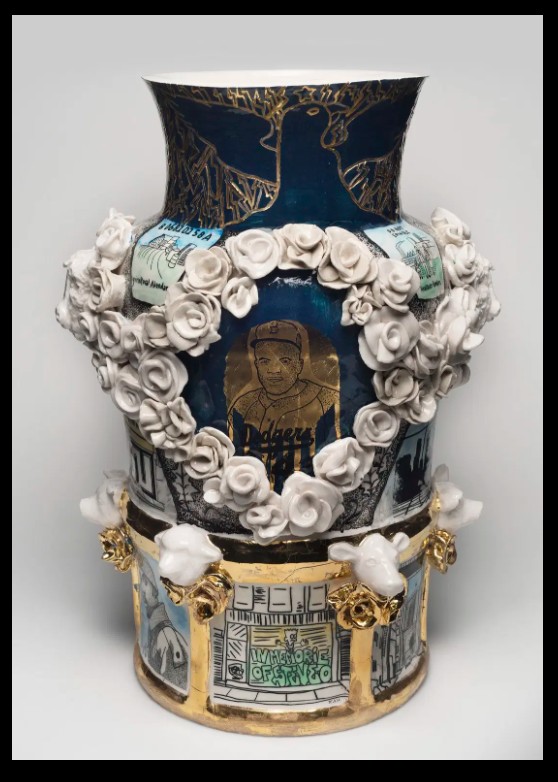
This porcelain vase borrows the original’s general form to revise its national statement to celebrate Brooklyn. The format of vignettes of people and sights is retained as well as the eagle and lightning on the top rim in bold and loose rendering. But the earlier bas-relief of our first president is replaced with Brooklyn icons including Jackie Robinson, Notorious B.I.G., and the Brooklyn Bridge, and vignettes feature the sights and textures of the borough. In this historical reboot the contemporary version celebrates our local community’s people and places as it elicits a fresh examination of the older piece - critiquing its symbolism while saluting its aesthetics and commemorating the Greenpoint industry that produced it.
This blog post reflects the opinions of the author and does not necessarily represent the views of Brooklyn Public Library.
Post a Comment
While BPL encourages an open forum, posts and comments are moderated by library staff. BPL reserves the right, within its sole discretion, not to post and to remove submissions or comments that are unlawful or violate this policy. While comments will not be edited by BPL personnel, a comment may be deleted if it violates our comment policy.
eNews Signup
Get the latest updates from BPL and be the first to know about new programs, author talks, exciting events and opportunities to support your local library.