Content note: This story contains strong language, descriptions of violence, and descriptions of racism.
This is the second part in a series, A Hanging in Brooklyn. Read part one here. Read part three here.
"Jefferson the hateful ruffian has been lost sight of, and another person has been executed, namely, the interesting colored man, to save whose soul pious friends entered into competition, to nurture whose physical body the ingenuity of womankind has been set in action and to study whose anatomy learned professors in great numbers have been invited."—Brooklyn Daily Eagle, August 1, 1884.
Before Alexander Jefferson became “interesting” to doctors, reformers, and Christians, he had first to be painted as a “hateful ruffian”. After the initial horror of Jefferson’s crime, his trial in March of 1883 brought fresh news coverage, shedding more light on the precipitating events.
The first crusader who attached himself to Jefferson was his counsel, George F. Elliott. Elliott’s insistence on appealing Jefferson’s case all the way to the Governor is responsible, in part, for the public attention this case received. His motive for doing so is not apparent in the newspapers, nor was I able to find any personal papers to shed light. Though it is admirable that he attempted to preserve Jefferson’s life, his repeated appeals were at times directly contradictory to his client’s stated wishes. As part of the appeal process, Elliott had a transcript of the original trial published for $200.40, paid for by the Board of Supervisors. Typically, only trials that were appealed had published transcripts, so it is thanks to Elliott’s perseverance that we have verbatim accounts from the parties involved, rather than just sensationalized newspaper accounts.
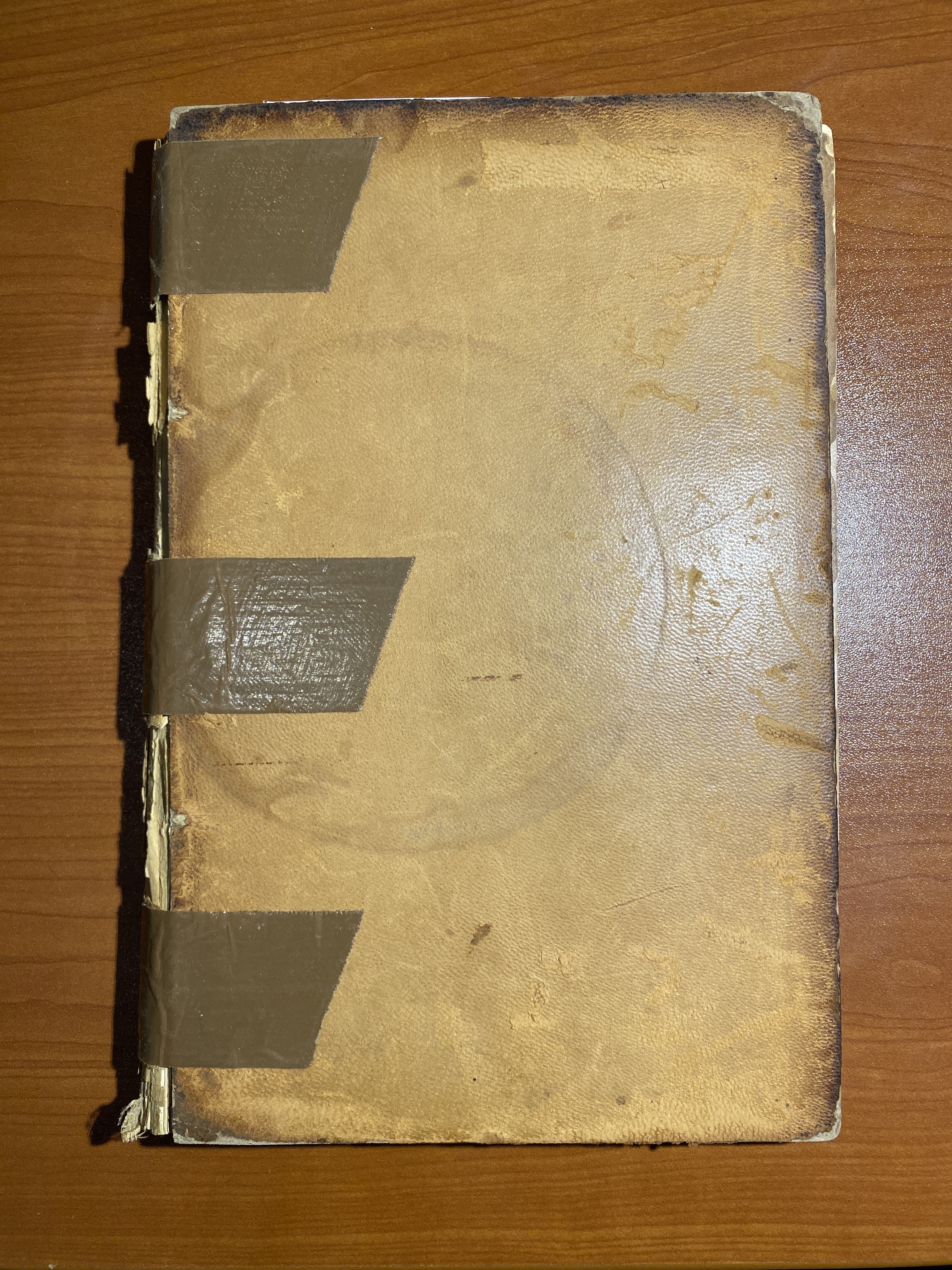
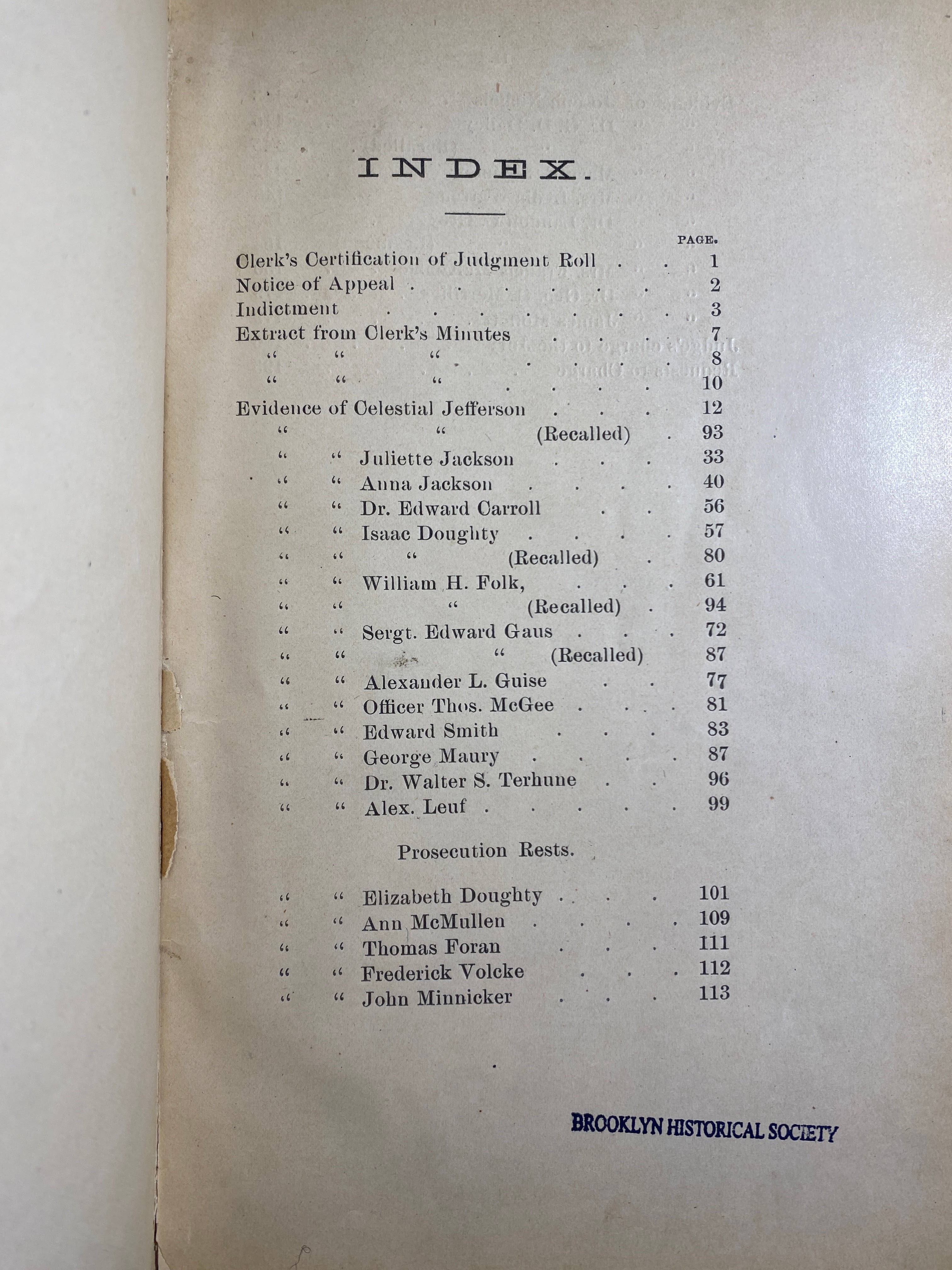
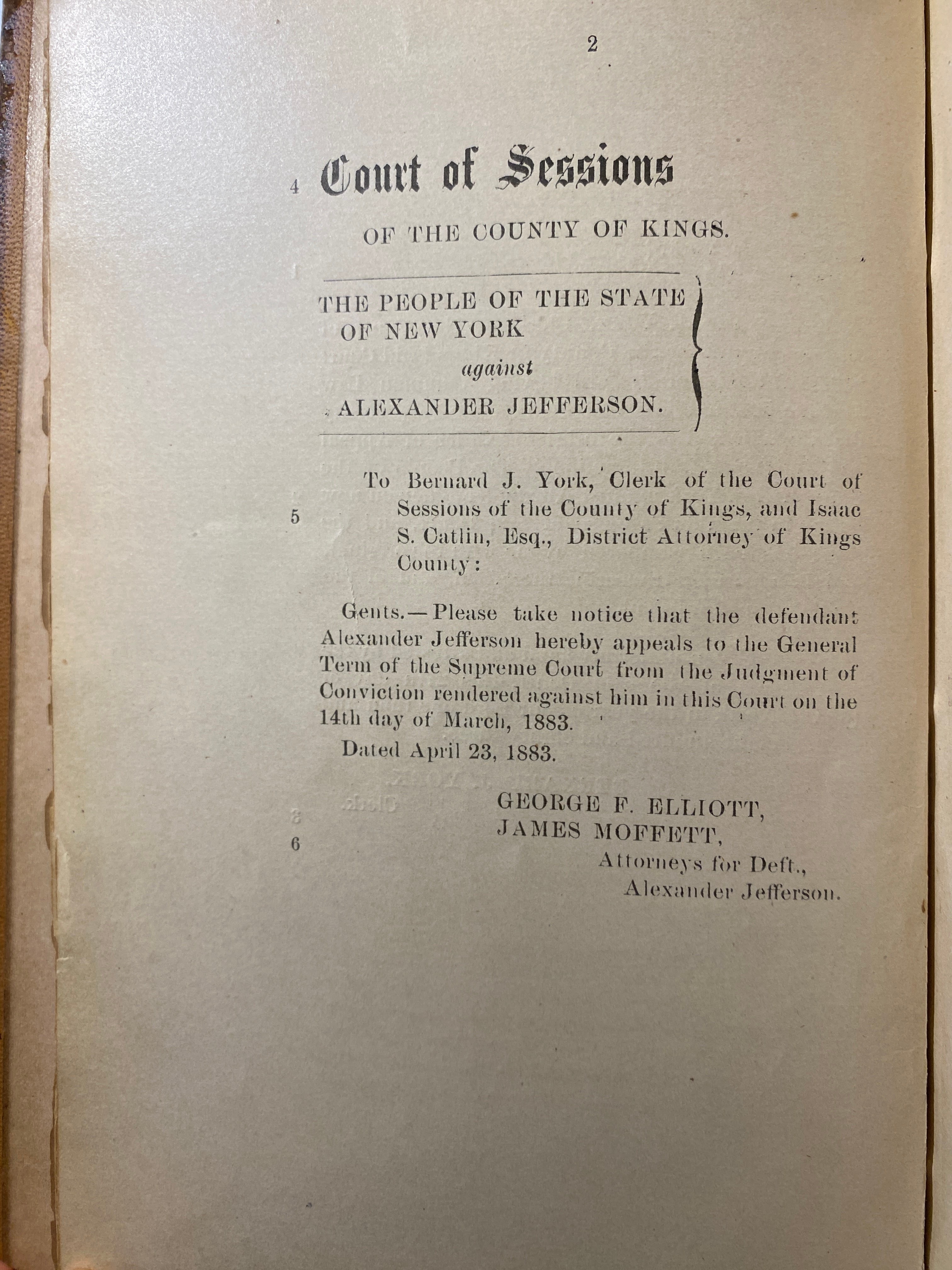
People of the State of New York against Alexander Jefferson, F223 .J45 1883, Center for Brooklyn History, Brooklyn Public Library.
Elliott was optimistic for the outcome of this first trial, and focused squarely on an insanity defense. This was in keeping with the zeitgeist of 19th century social reforms; whether Elliott was himself a reformer or an eager attorney using any tool at his disposal is unclear. Reporting also hinted at both Jefferson’s outspoken autonomy and his lack of prudence: “The murderer himself, however, is not willing to put in such a plea, maintaining that the wrongs he suffered fully justified him in carrying out his terrible act of vengeance.”
The public soon learned of the wrongs Jefferson had suffered. It was an age-old motive: love, betrayal, and jealousy.
The first person to testify at the trial was Celestial Jefferson, Alexander’s younger brother. The brothers’ closeness, and the anger and grief between them is evident in trial transcripts and newspaper reporting. The Brooklyn Union described Alexander Jefferson as “a small, young, very black man, with goatee and moustache”. Celestial was “a young man of prepossessing appearance, taller, and lighter of complexion than Alexander”. In court, they wrote, “The eyes of the brothers wandered calmly over all else, but never met each other". Celestial testified that he “was always on good terms with [Alexander]”1. Though younger than his brother, Celestial appears from the trial transcript to have been the more responsible of the two. He travelled to Flatbush for work, where he did chores for Kippy, an elderly and disabled “chimney sweep and gardener”, who gave him twenty shillings for every five dollars he made2. Discussing his relationship with his brother, he told the court:
“I was never angry with him, always tried to talk to him for his own benefit to help him along, build him up and keep him out of trouble; find him work and give him things to go to housekeeping; we would have words but I never would mind it, never took it to heart; sometimes we would have a few spats that didn’t amount to anything".3
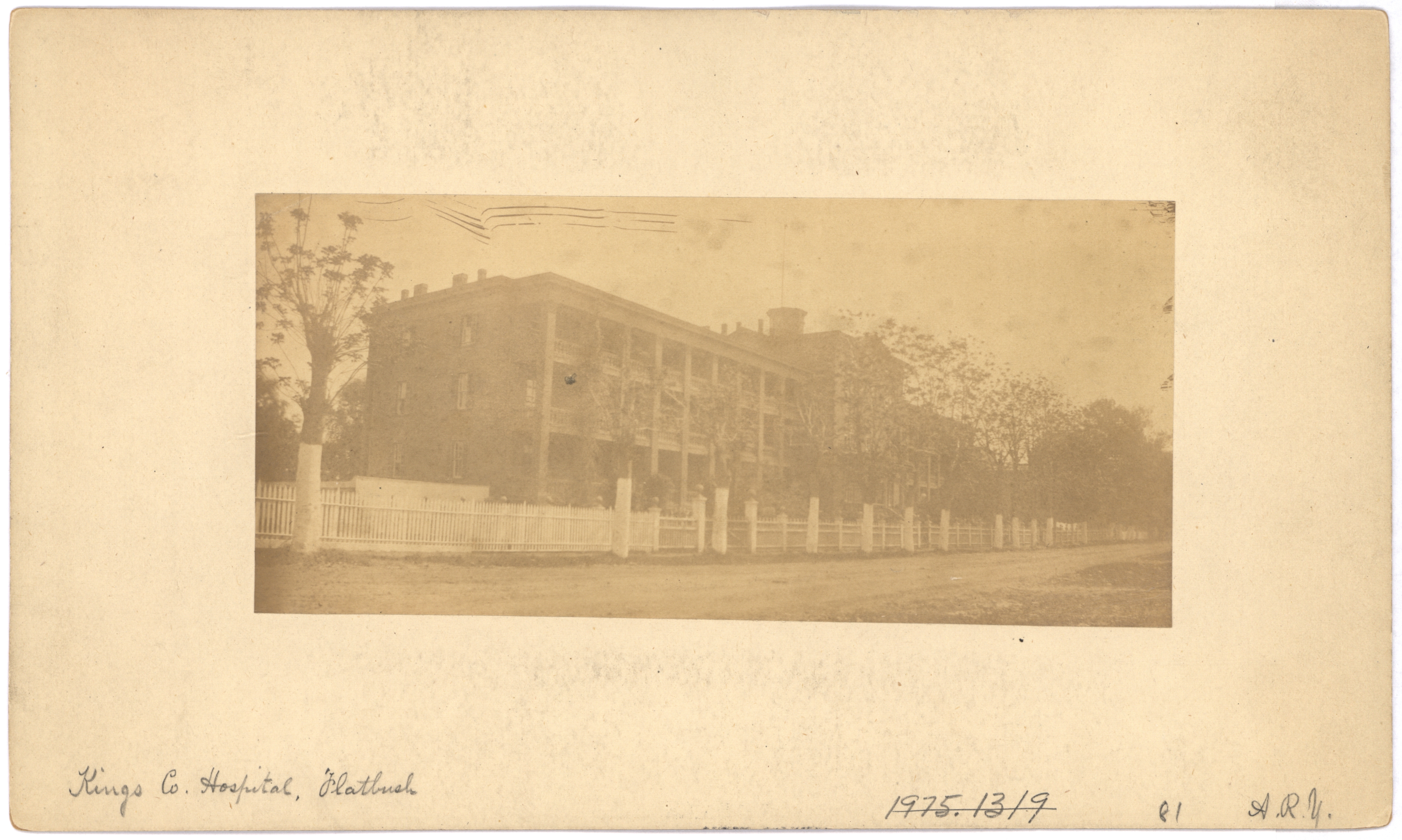
The trouble between the brothers began with their relationship to Annie Jackson, the woman who survived the stabbing at 177 Buffalo Avenue. The brothers knew Annie from childhood, growing up near each other in Crow Hill. Once they were grown, Annie and Jefferson began to see each other romantically. Eventually, they “were living together as husband and wife” in a one story home on Buffalo at St. Marks.4 Jefferson insisted they get married, but Annie was opposed. Jefferson went to sea for two months to work and when he returned, he began hearing rumors that Annie had been unfaithful to him. Then, Jefferson was diagnosed with venereal disease. The disease got so bad that he was admitted to the Kings County Hospital for an extended stay, where Dr. Edward Carrol diagnosed him with gonorrhea, complicated by prior conditions. He blamed Annie for this disease and, once returned from the hospital, moved out of their shared home to that of a friend, Isaac Doughty’s, on Hunter Fly road near St. Marks avenue.5
There is no strong indication that Celestial and Annie were linked romantically, but after the dissolution of her household with his brother, Annie moved back in with her mother, where Celestial also lived. Celestial and Annie remained on good terms, but Jefferson, upset at the breakup and isolated from their household, grew more agitated. One day, as Annie and Celestial walked to the packing house for meat, Jefferson followed them, repeatedly asking Annie who she was “going with” and whether she was “going to get married”, according to Annie; according to Jefferson, he was demanding she admit to giving him gonorrhea.6
Jefferson began escalating his threats against all of the residents of 177 Buffalo avenue. On one occasion, he solicited the tenant Juliet Jackson for sex, asking her to roleplay as Annie, and threatened her with force when she refused. He took a pair of scissors and “fooled” them around her neck until she asked him to stop. On another occasion, he followed Annie while she was out with friends and struck her in the face on a street corner.7
At home with Isaac, his behavior grew bizarre. He no longer went out at night or to the store, only went to work and then returned home, where he would “squat down the same as a man fifty years of age”. Isaac would ask him questions and he gave short answers, before growing silent and dropping his head. “I couldn’t understand it,” the older man, Isaac, said, “a boy of about twenty seven years of age being like an old man of a hundred and fifty”. Still, Jefferson was never a big drinker and he seemed to be sober while living with Isaac and Isaac’s wife, Elizabeth.8
A few days before the killing, Elizabeth encountered an intoxicated Jefferson returning home with his pants ripped, in a distressed state. He began hiding her bread knife and lying about it. On four occasions, she found it hidden behind a shelf. The night before the killing, he drank all of the beer she brought home for her and Isaac. On the night of the murders, he was again deeply intoxicated, with a “glisten” in his eye.9
Jefferson had been working at Alderman Kenna’s on St. Mark’s avenue, where he may have been doing some gardening work and had access to a knife-sharpening tool. It was there that, not long before the murders, he took a knife and ground it to a sharp point.10 On the 21st, with the knife and Isaac's gun, he walked to 177 Buffalo avenue, where he killed Henry Hicks and Emma Jackson and wounded Celestial Jefferson and Annie Jackson.
Though the press and law enforcement hated Jefferson’s crimes and regarded him as a brute, they were not in equal parts sympathetic to his victims. Annie was arrested on Saturday, January 27th, 1883, a month after the night where she was brutally stabbed nine times and her mother was murdered, so that she might be “detained as a witness” for the trial. Whether she was detained for the full six weeks leading to the trial is unknown. To some, Annie was partially responsible for Jefferson’s crimes. An Eagle sub-headline read, “Girl who received nine stab wounds and was the real cause of the killing". At the trial, the defense named multiple men that Jefferson accused Annie of being with while he was at sea.11 Other articles implied that she was in the wrong for not visiting him in jail. Not all held this view, however.
Though George F. Elliott’s insanity defense relied on psychological concepts that are unheard of today (ie “circular insanity”12) and are hard to track to modern conditions, there are certain details from Jefferson’s biography that stand out. A fall and a knock to the head as a child of five or six and, in adulthood, severe sunstroke. The advanced venereal disease that required hospitalization and after which he appeared increasingly unstable. Elizabeth Doughty testified that she would bandage his head with vinegar-soaked rags when he complained of pain, which was ongoing for several years. Mrs. Francis McKenzie, an older woman who had known Alexander and Celestial Jefferson’s mother and father, testified that his mother “would start away from home and leave her children; she died in some institution”.13
Elliott’s greatest obstacle to an insanity plea was a set of letters discovered on Jefferson the night he was captured. The letters detailed his intention to kill Annie and expressed his upset at Celestial and Emma. It was difficult to argue for an insanity defense when the culprit had so blatantly recorded his premeditation. Still, he brought on multiple character witnesses to testify to Jefferson’s sunstroke and mental condition, and multiple psychologists that he asked a series of circular questions to, often arriving back at the idea that to do something insane meant one was insane. The very act of committing a crime so violent meant that its perpetrator had to be mad. One expert, a Dr. Daily, testified that patients at the asylum where he worked often wrote threatening letters, but that they were still insane. Dr. Landon C. Grey of Bellevue hospital testified for the prosecution that, “so far as any medical skill can determine the fact, [Jefferson] was perfectly sane”.14
The lawyers made their cases; the jury retired. On March 15, 1883, the jury found Jefferson guilty. Shortly after 10 am on the morning of March 22, 1883, in the Court of Sessions Judge Moore read out the sentence: "to be hanged by the neck until death". Jefferson stood before him, arms crossed behind his back, head bowed.
On the way out of the courtroom, Elliott told a reporter that he intended to appeal the decision. In spite of the gruesomeness of the crime, in spite of the letters, in spite of the guilty verdict, Elliott believed he could get his client off.
Due to the length of this post, the rest of the story, including the involvement of reformers, Jefferson's autopsy and the proposal that his bones be displayed in a museum, as well as the lonely scene of his burial, will be in Part 3.
1 People of the State of New York against Alexander Jefferson (New York: Publisher not identified, 1883), p. 18.
2 People, p. 19-20.
3 People, p. 27.
4 People, p. 33, 40.
5 People, p. 49, 56, 51, 57.
6 People, p. 43-44.
7 People, p. 38, 52.
8 People, p. 60.
9 People, p. 104-106.
10 People, p. 68-69.
11 People, p. 55.
12 People, p. 198.
13 People, p. 105, 150.
14 People, p. 146, 157.
This blog post reflects the opinions of the author and does not necessarily represent the views of Brooklyn Public Library.
Post a Comment
While BPL encourages an open forum, posts and comments are moderated by library staff. BPL reserves the right, within its sole discretion, not to post and to remove submissions or comments that are unlawful or violate this policy. While comments will not be edited by BPL personnel, a comment may be deleted if it violates our comment policy.
eNews Signup
Get the latest updates from BPL and be the first to know about new programs, author talks, exciting events and opportunities to support your local library.