New York City’s recent election of Mayor-Elect Zohran Mamdani is historic for a few reasons- he will be New York’s first Muslim mayor, the first immigrant mayor from a non-European country, and at 34, he is one of the the youngest New York City mayors in history. But he’s not the only young mayor who celebrated an election night win in Brooklyn. In fact, former mayor of the City of Brooklyn Seth Low had already completed two terms as mayor by his 34th birthday! He also went on to serve for one year as New York City mayor from 1902-1903, after the cities consolidated in 1898. So it feels appropriate to take a moment to dive into the history of Brooklyn’s “boy mayor,” Seth Low.
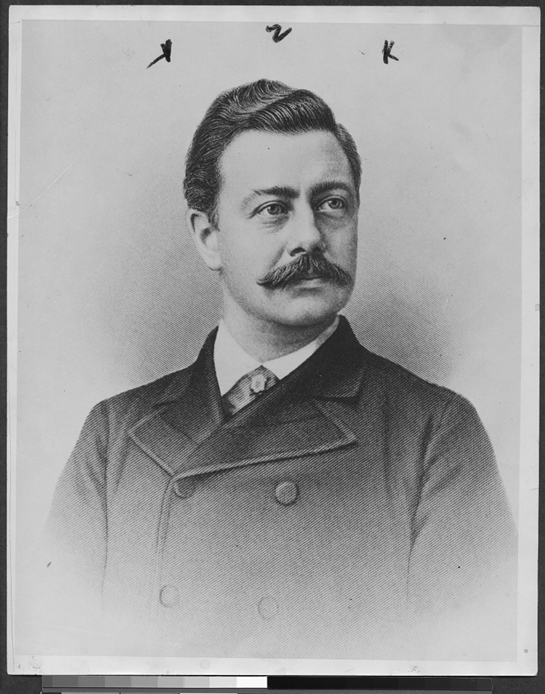
Brooklyn Daily Eagle photographs, Brooklyn Public Library, Center for Brooklyn History
On January 18th, 1850, Seth Low was born into a Brooklyn dynasty of wealth and connections. He was named after his grandfather Seth Low (1782-1853), who was one of the men who first incorporated the Village of Brooklyn into the City of Brooklyn in 1834 and served as the city’s first Board of Education president. His son, and Seth Low The Younger’s father, Abiel Abbot Low, was also a well-known Brooklynite—in fact, he was among the original board members of the Long Island Historical Society, the precursor to our very own Center for Brooklyn History!
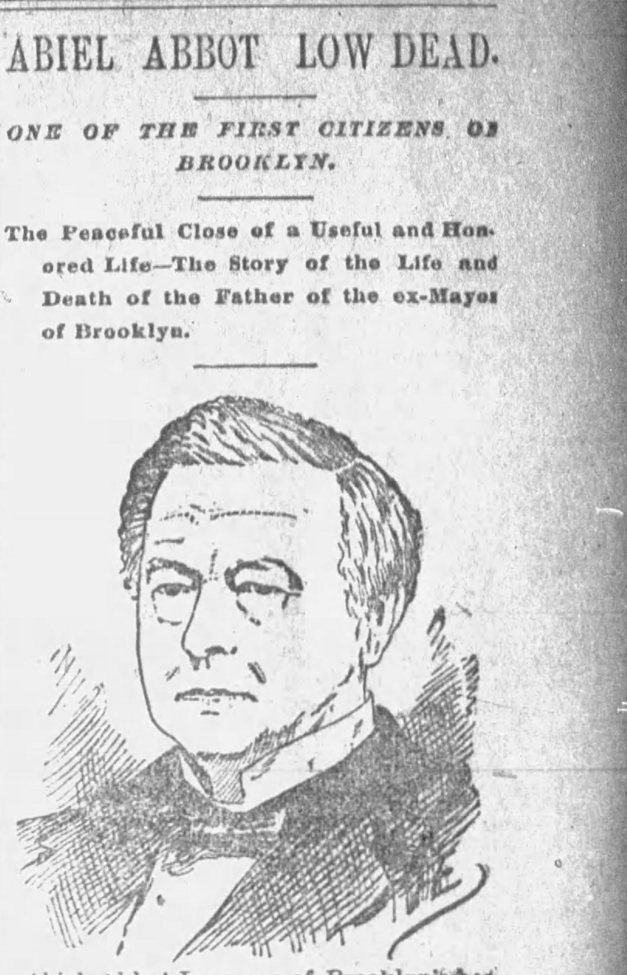
Sat, Jan 07, 1893 ·Page 1
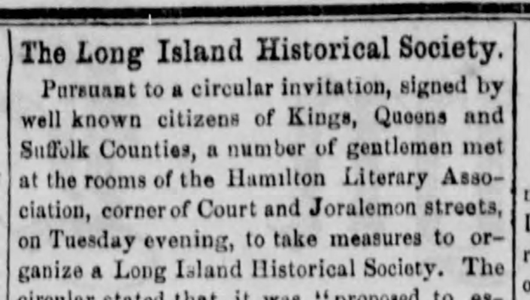
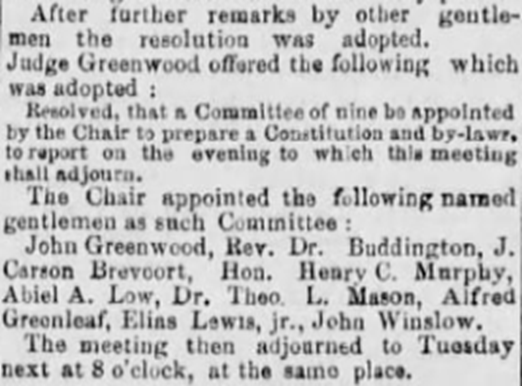
Sat, Mar 07, 1863, page 2
After Seth's mother died in childbirth, his father Abiel A. Low married his sister-in-law (sister-in-Low?) Ann Low. The family moved from Clinton Hill to Pierrepont Street, just down the road from today’s Center for Brooklyn History. After graduating from Brooklyn Polytechnic Institute (now NYU Tandon), Seth attended Columbia College, where he was described by classmates as “vigorous and plucky” and “joyous and natural,” and by the College president as “the first scholar in college, and the most manly young man we have had here in many years.”
He graduated as Columbia valedictorian in 1870, and attempted working for his father in the family merchant business, but soon discovered his heart wasn’t in becoming a businessman. After volunteering with an organization serving the poor in Brooklyn, he decided to commit his career to public service, establishing the Brooklyn Bureau of Charities in 1879. A year later, he married Annie Wroe Scollay Curtis, the daughter of Supreme Court Justice Benjamin Robbins Curtis (famous for being one of the two dissenting voices in the historic 1857 Dred Scott v. Sandford Supreme Court case, writing his opposition to the idea that a Black man could not be a citizen of the United States). Seth had a new wife, he had a new purpose, and Brooklyn would soon have a new mayor.
Seth began differentiating himself in politics by campaigning for 1880 Republican presidential candidate James Garfield. He set up the “Garfield and Arthur Campaign Club” and became known for his political ground game, galvanizing a group of 800 young people in Brooklyn to volunteer, canvas door-to-door, and amass large crowds at speaking engagements. The election was a success (even if Garfield’s presidency wasn’t), and Low had built a reputation, not only as someone who got things done, but also as a voice of integrity that could combat the political corruption rampant in New York City and Brooklyn in the late 19th century. As the next year’s campaign for the Brooklyn mayoral election got underway, this impression lingered in many minds.
Initially, Low was not interested in holding office, and even released a letter to the press in early 1881 insisting that he didn’t wish to be considered for any nomination. But as the election year went on and no clear Republican candidate seemed to emerge to run against incumbent Democrat James Howell, by October the party was desperate. Seth Low made an impassioned speech at a nominating convention to convince his fellow Republicans to rally behind someone else, progressive candidate Ripley Ropes, but only succeeded in further impressing those in attendance, garnering “prolonged and deafening applause.”
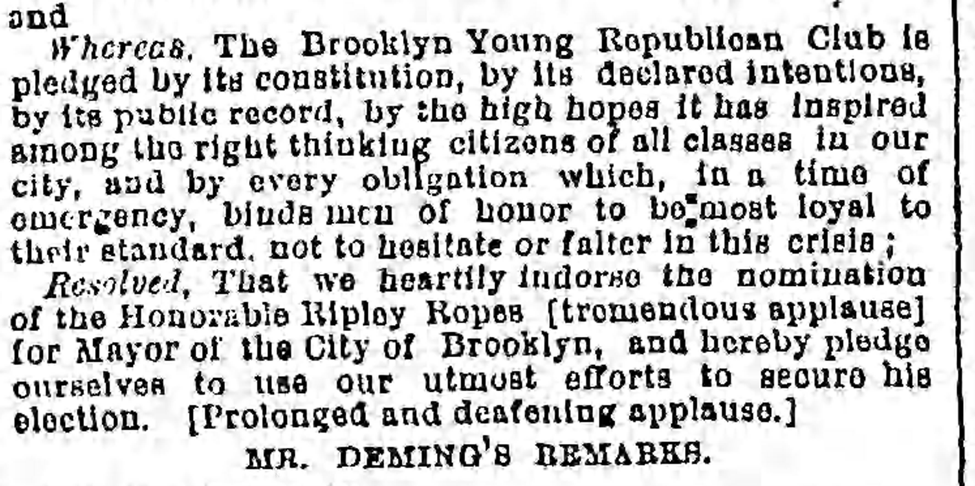
Sun, Oct 23, 1881, page 6
Instead of Ripley Ropes, the Republicans nominated Low on the spot, and he acquiesced and accepted. With just weeks in the campaign season remaining, he launched into the same ground game that he used to drum up the vote for Garfield, holding nightly public speaking engagements where he took questions from the audience, instantly winning many over. During one event, accused of just being “a rich man,” Low slangily quipped back “Well, my friends, what if I am? 'A man's a man for a' that!'” The charm offensive worked. Just days later, on November 8th, 1881, and only two months before his 32nd birthday, Seth Low was elected mayor of Brooklyn.
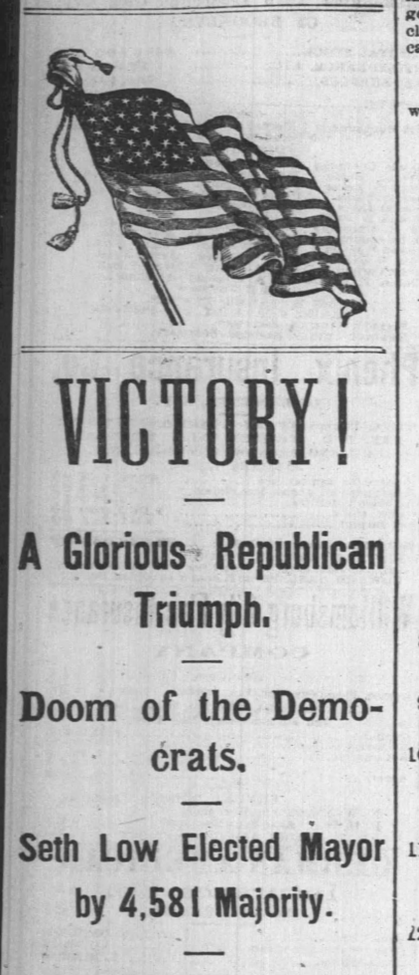
Wed, Nov 09, 1881, page 5
Low's two terms as mayor of Brooklyn from 1881-1885 are marked by progressive reform in social welfare, particularly in the school system that his grandfather had helped to establish. He personally sat in on classes and offered feedback, made textbooks for public school pupils free, and appointed Brooklyn’s first Black member of the Board of Education, Phillip A. White. In 1882, he set in motion the integration of public education in Brooklyn. Under his administration, hundreds of black schoolchildren began attending formerly all-white neighborhood schools for the first time.
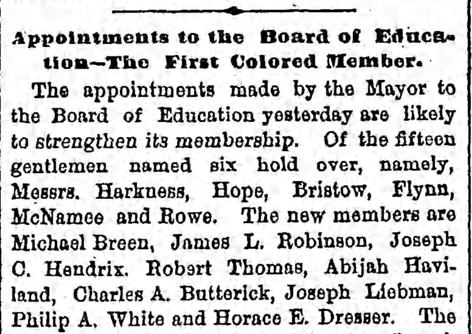
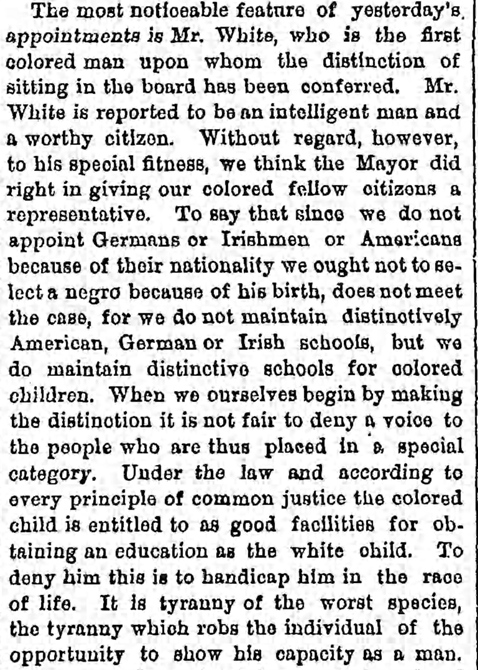
Tue, Jul 11, 1882, page 2
Low also was present for one of the most storied days in Brooklyn’s history, the May 23, 1883 opening of the Brooklyn Bridge. New York City Mayor Franklin Edson and United States President Chester A. Arthur walked from the Manhattan side of the bridge to the Brooklyn side, where both the stately 50-somethings symbolically shook hands with Brooklyn’s boyish young mayor.
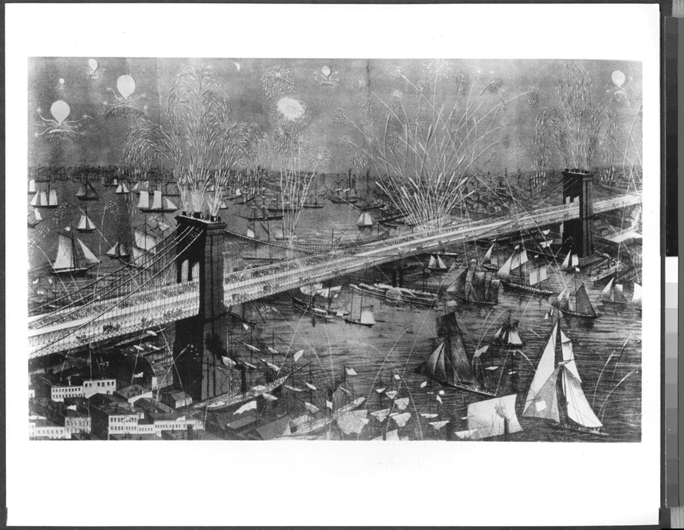
Brooklyn Daily Eagle photographs
Soon, it would be Seth Low himself bridging the divide between Brooklyn and the rest of New York; after declining to run for a third term as Brooklyn mayor, he became president of his alma mater Columbia College, transforming it into Columbia University, and moving its location from Midtown Manhattan to its current home in Morningside Heights. He worked with McKim, Mead, and White to design the Greek revival architecture that characterizes the campus to this day (Seth loved studying Greek as a college student and “made it appear a trifle to repeat the complicated choruses of Aeschylus and Sophocles as if they were welling up from out his own mind.”)
Low then again accepted the nomination of his party to run for New York City mayor in 1902, and became mayor of all five boroughs of Greater New York City. Under his mayoralty, which lasted just one year, Mayor Low would get to open yet another bridge spanning the East River, the Williamsburg Bridge, in 1903.
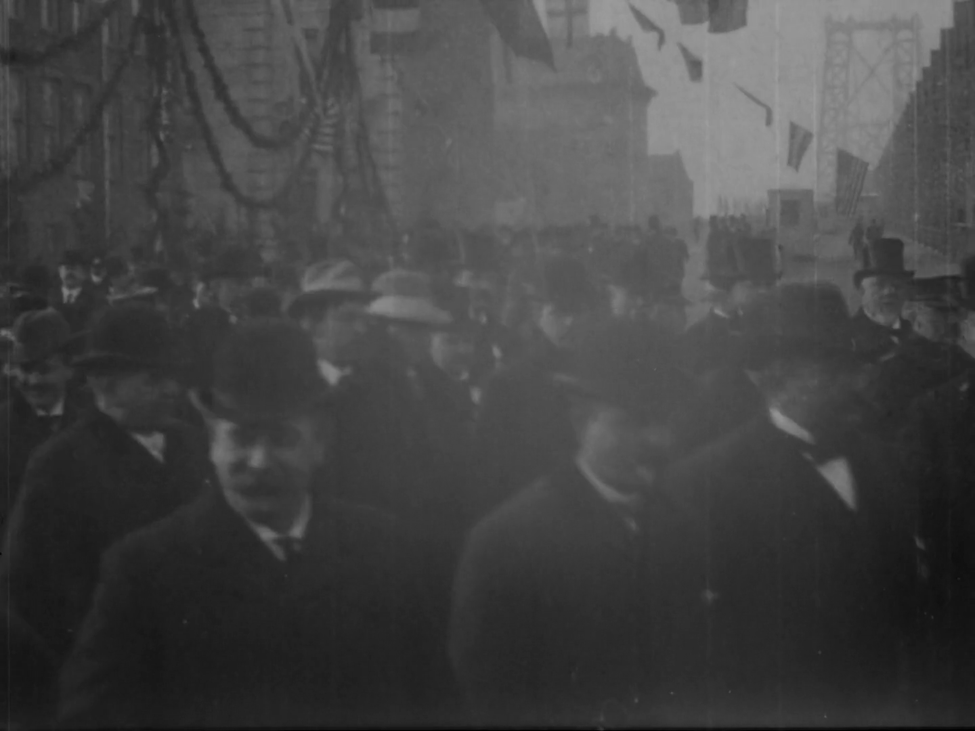
Library of Congress Motion Picture, Broadcasting and Recorded Sound Division
As NYC mayor, he continued prioritizing social welfare and schools, instituting a school immunization policy that greatly reduced the death rate from communicable disease. Smallpox alone fell from 410 deaths a year in 1901 to just a handful by 1903. But Low lost his bid for re-election against Tammany Hall Democrats in 1903 to George P. McClellan.
With his career in politics abruptly ended, Low entered life as a private citizen, but he did not exit his career of public service. In 1905, he joined both the National Civic Federation and the Board of Trustees at the Tuskegee Institute in Alabama, founded by Booker T. Washington. Seth Low and the formerly enslaved educator exchanged letters for many years about their vision to reform education and their mutual interest in agriculture (Low later maintained a farm in rural Bedford Hills, NY) Low also committed to advocating for immigrant rights, serving for years as president of the American Asiatic Association, declaring in the face of rising anti-Chinese sentiment that “Somehow, I hope that California will work out a relationship to the East, which will involve no discrimination based upon race or nationality.” He also supported workers’ rights and collective bargaining, telling the National Civic Federation in 1912: "My judgment is that the pathway to industrial peace and industrial efficiency is to be found in the hearty co-operation of employers with labor unions.” Upon his sudden death in 1916, perhaps no better symbol of this belief in cooperation was the fact that both banking tycoon J.P. Morgan Jr. and labor activist Samuel Gompers attended his funeral.
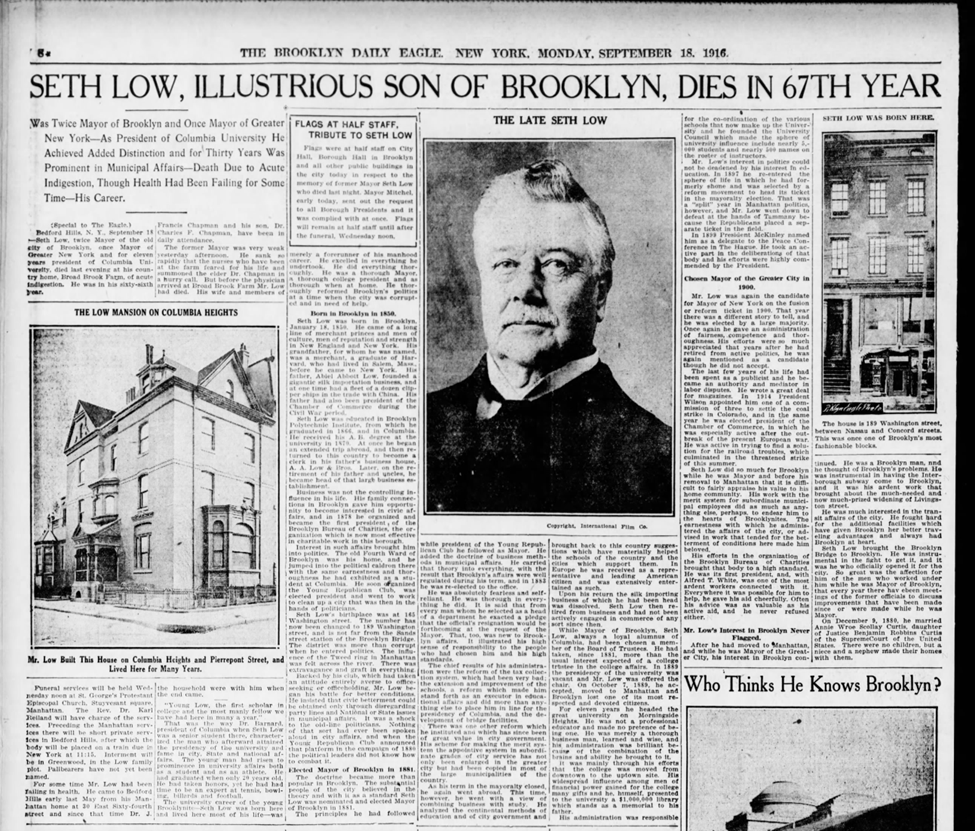
Mon, Sep 18, 1916 , page 26
While known by some as not being particularly warm and friendly (“patrician” is a word that comes up often in descriptions of him), Seth Low’s legacy is as a Brooklyn native, passionate about the potential of the city during a time of both growth and challenge, and supported repeatedly at the polls by New York City’s electorate. From the bridges we cross to the diversity we embrace, we live today in a city that Seth Low, the only man to serve as mayor of Brooklyn and New York City, left his mark on:
"...The great city can supply the human quality which the broad-minded man must not suffer himself to lack. There is a variety to life in this city, a vitality about it, and, withal, a sense of power, which, to my thought, are of inestimable value...There is but one New York on all this continent, and ... as there is no solitude like that of a crowd, so there is no inspiration like it”
This blog post reflects the opinions of the author and does not necessarily represent the views of Brooklyn Public Library.
Post a Comment
While BPL encourages an open forum, posts and comments are moderated by library staff. BPL reserves the right, within its sole discretion, not to post and to remove submissions or comments that are unlawful or violate this policy. While comments will not be edited by BPL personnel, a comment may be deleted if it violates our comment policy.
eNews Signup
Get the latest updates from BPL and be the first to know about new programs, author talks, exciting events and opportunities to support your local library.