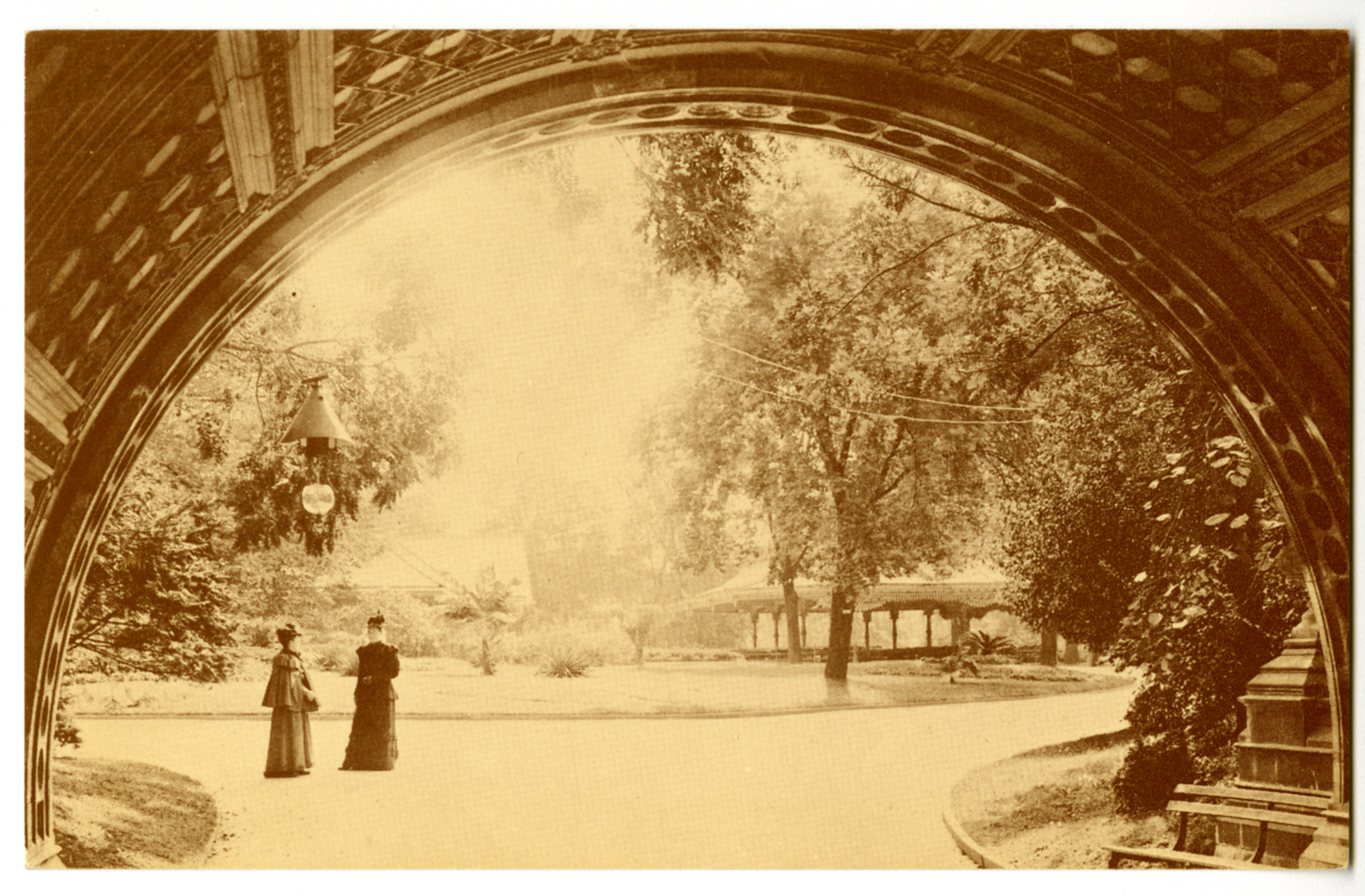
One of Prospect Park’s many great features is its free summer concerts. Today, these concerts are held at the Lena Horne Bandshell, which has hosted musical performances annually since 1979. In fact, free musical performances were part of the park’s original plans. All the way back in 1866, when Frederick Law Olmsted and Calvert Vaux took over the park's design, they drew up a large area dedicated to the enjoyment of free music by boat, carriage, and land. This space was not where the bandshell stands today, but was across the park, on the eastern edge, just north of today’s LeFrak Center. Appropriately, they named the area Concert Grove.
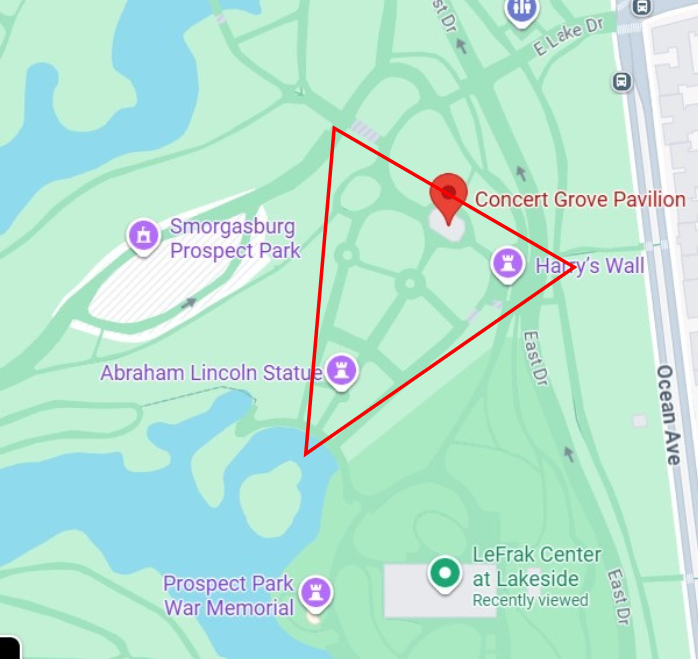
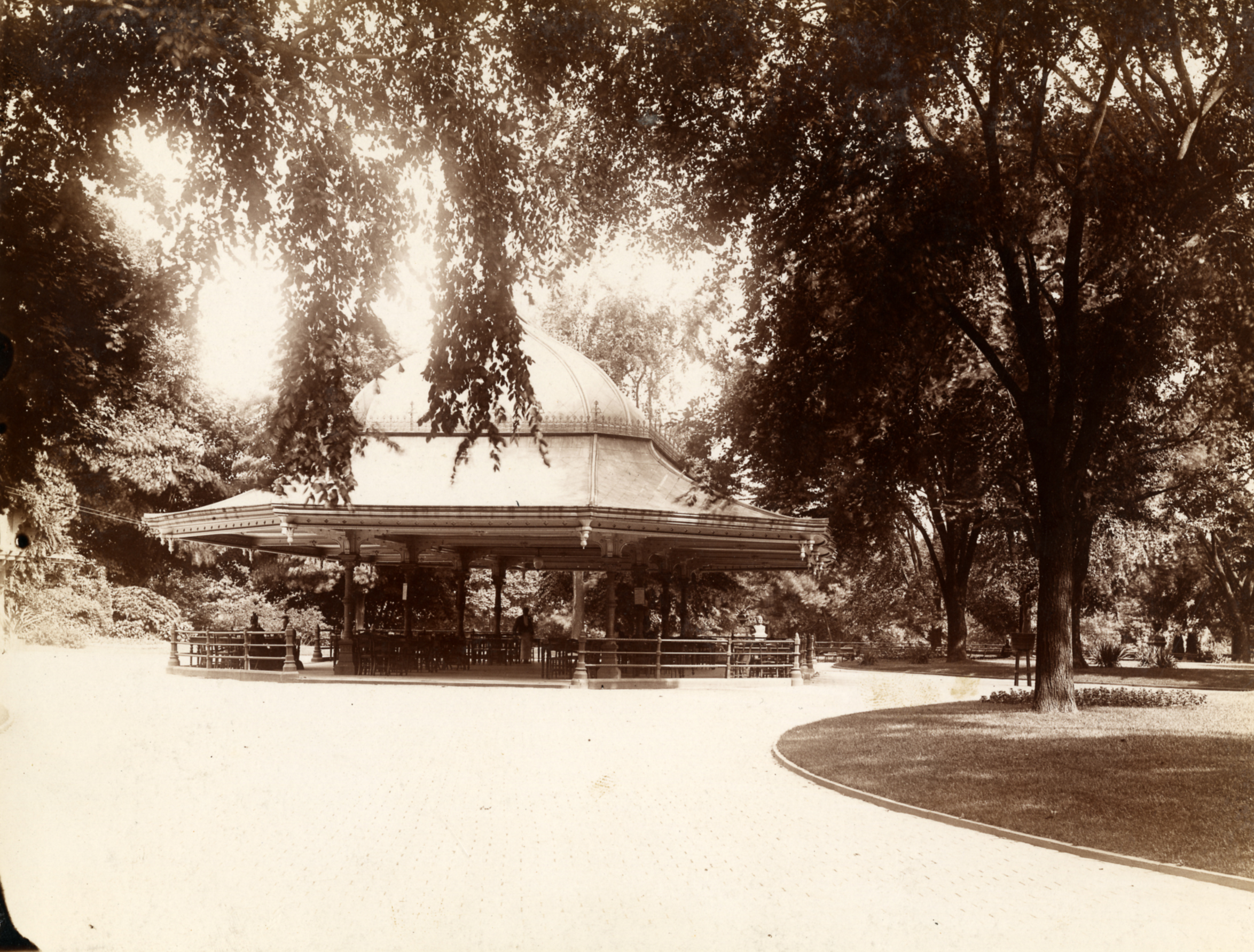
Today, what remains of the grove is a wedge-shaped space crowned by Concert Grove Pavilion and footed by a narrow section of Prospect Park Lake. The pavilion consists of an unusually voluptuous roof that stands on eight brightly painted cast iron pillars, surrounded by a low iron fence.
Between it and the lake lie terraced lawns, sectioned by paved pathways and stairs, that are home to several bronze busts of composers and one full-length statue of Abraham Lincoln. Below, the grove narrows at the lake, stopping abruptly at the water’s edge. Nothing within Concert Grove resembles a concert venue. The pavilion is a possible option, as the only structure in the space, but it seems to stand at the wrong (wide) end of the wedge. So where exactly did Concert Grove’s concerts take place?
Olmsted and Vaux were meticulous in their designs. They considered the experiences of boaters, carriage riders, and pedestrians. They controlled sightlines throughout the park and orchestrated transitions from one area to the next. As Olmsted put it in Frederic Law Olmsted: Designing the American Landscape (1995):
A park is a work of art, designed to produce certain effects upon the mind of men. There should be nothing in it, absolutely nothing--not a foot of surface nor a spear of grass--which does not represent study, design, a sagacious consideration & application of known laws of cause & effect with reference to that end.
Much of Olmsted and Vaux’s specific vision has been lost as the park evolved under different commissioners, adapted to modern needs, and survived a few fires, yet the basic foundations of the space remain and reference what was intended -- if one knows where to look.
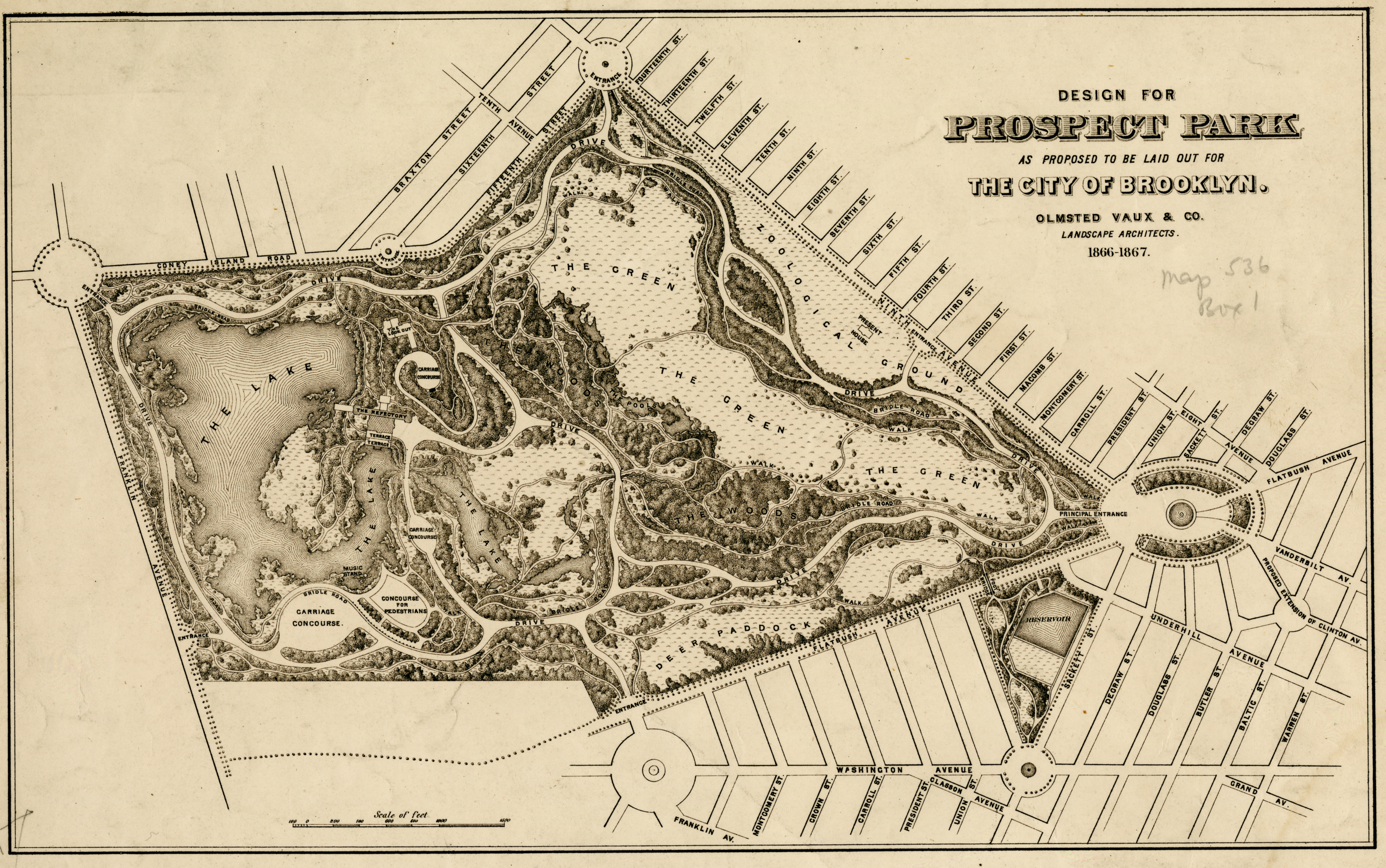
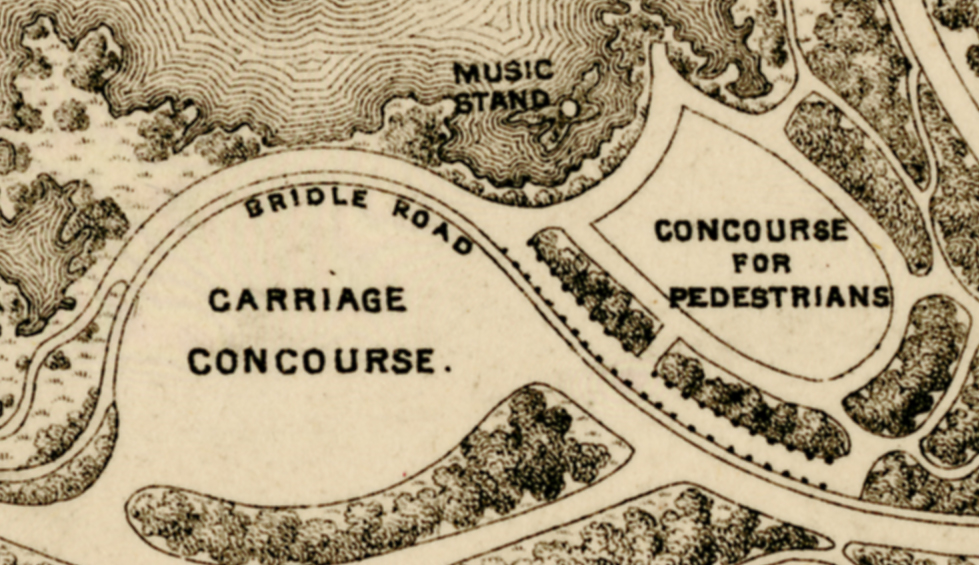
This 1866-1867 design of the Concert Grove area shows a large carriage concourse framed on one side by Bridle Road, which rolls along the water’s edge to a “concourse for pedestrians,” or what would soon become the Concert Grove wedge. At the front of the future grove, a small, wooded island encircled by the lake is labeled “music stand.” This little island, now quite overgrown and unused, was the focal point from which all aspects of Concert Grove stemmed. It was there that the concerts were performed, the music floating out across the park for all to enjoy.
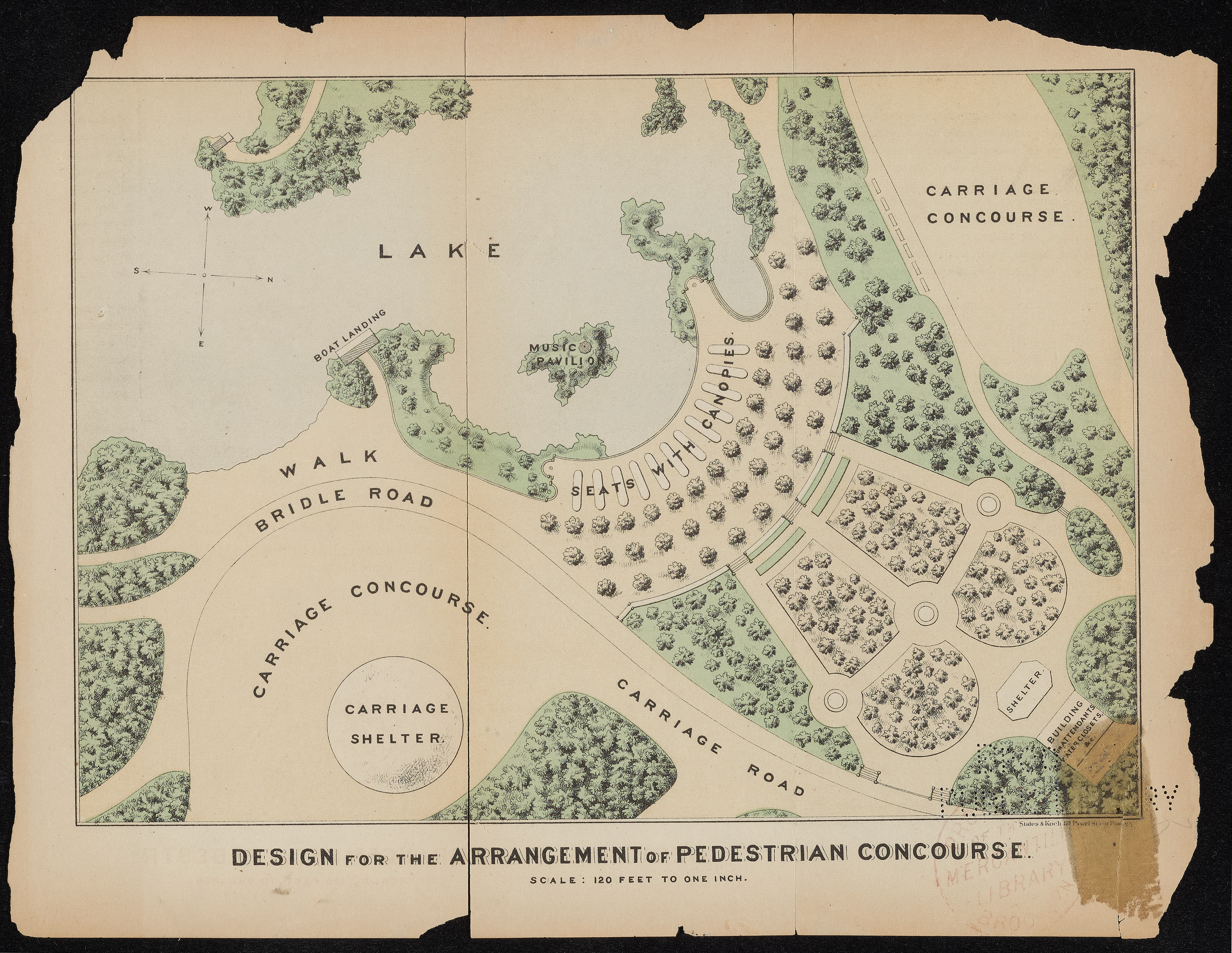
This 1871 design reveals the full plan. The wedge points at the music stand, labeled Music Pavilion (also called Music Island in other plans), where wooden bandstands were constructed each summer. On land, across from the island, sit twelve canopied seats. They’re followed by the cultivated terraces (or gardens), which were intended to serve as picnicking grounds (as they still do) and croquet fields (not so much these days).
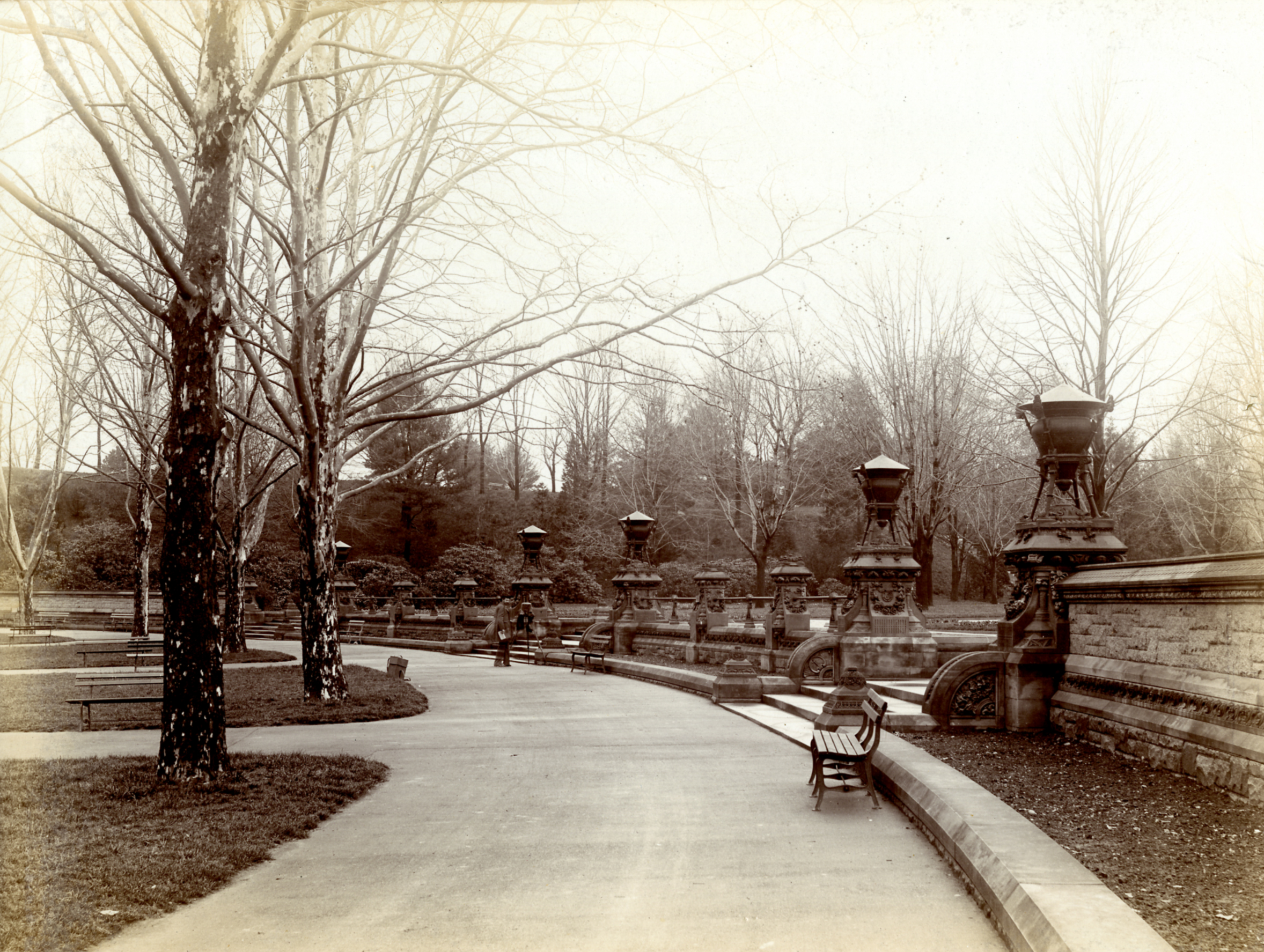
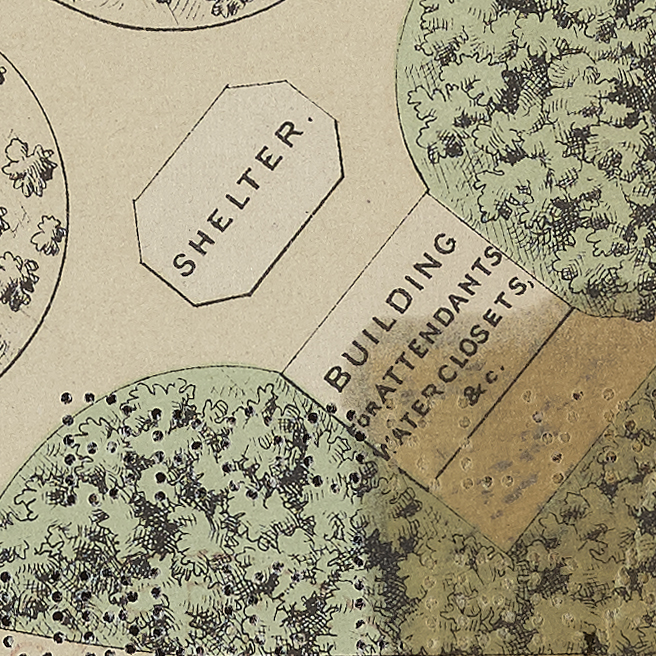
Following the terraces away from the water, we find a structure marked “shelter,” that being the voluptuous Concert Grove Pavilion, sometimes referred to as the Oriental Pavilion due to its architectural influences. Just beyond the pavilion stands another structure which no longer exists, labeled “building for attendants, water closets, &c.” If the pavilion has ever struck parkgoers as out of place, it’s because it’s missing its greater counterpart. What exactly was this other building? Let’s discover it with the help of a few new friends: promotional characters authored by the Kings County Rural Gazette in 1872.
While on a double date at the park, the fictional Alice, her friend Mary, and their gentlemen stop to admire a bust of Washington Irving in the moonlight (as youths are want to do), when one of them notices “the lights in the beautiful building standing at their left, directly opposite the bust, and wondering, exclaim[s]:”
“What’s that building?”
Strange as it may seem, none of them know; but a Park-keeper coming along at that moment, he informs them that it is called the CONCERT GROVE HOUSE and was opened on the 1st of June [1872] for the accommodation of parties who, taking carriages to the Park without attendant drivers or servants, desire to leave their vehicles, and either walk in the Park or take a sail on the lake, or play a game of croquet, or listen to the music of the band. To such the Concert Grove house provides, “cloak rooms,” for shawls, overcoats, etc.; boys to hold the horses; retiring rooms for ladies and gentlemen; needed refreshments, from a plain sandwich to the finest ice cream, at very reasonable prices; and even medicinal aid if necessary.
The Gazette continues:
In the future its surroundings will be such as to make it one of the central points of attraction of the Park, as directly in front of the building as it faces the Large lake, will be located the “Pedestrian’s” concourse, and ultimately, the Boating Plaza will be moved to this vicinity.
The party diverts to the lake for a moonlit sail before returning to the apparently-mesmerizing structure where…
…they are met at the doorway by the gentlemanly purveyor, Mr. Henry Bogert, with his kindly welcome of “Good evening, ladies and gentlemen; what can we do for you.” We find the bill of fare to consist of a fine variety, and so reasonable in prices that we are inclined to order it all, but our appetites failing us we select a few choice articles, and enjoying them so well, shall be sure to come again.
“And the house, oh, Mary! Isn’t it nice? So comfortable in all its arrangements, so convenient, and such a beauty too. And look, see that elegant temperance bar, with its silver-mounted marble soda-fountain; and how nicely ornamented everything is. I tell you what it is, I’m going to get a party of young folks, every week… and come over here and enjoy myself…”
So they strolled home highly delighted with their ramble; and we advise all our friends and readers to go and do likewise.
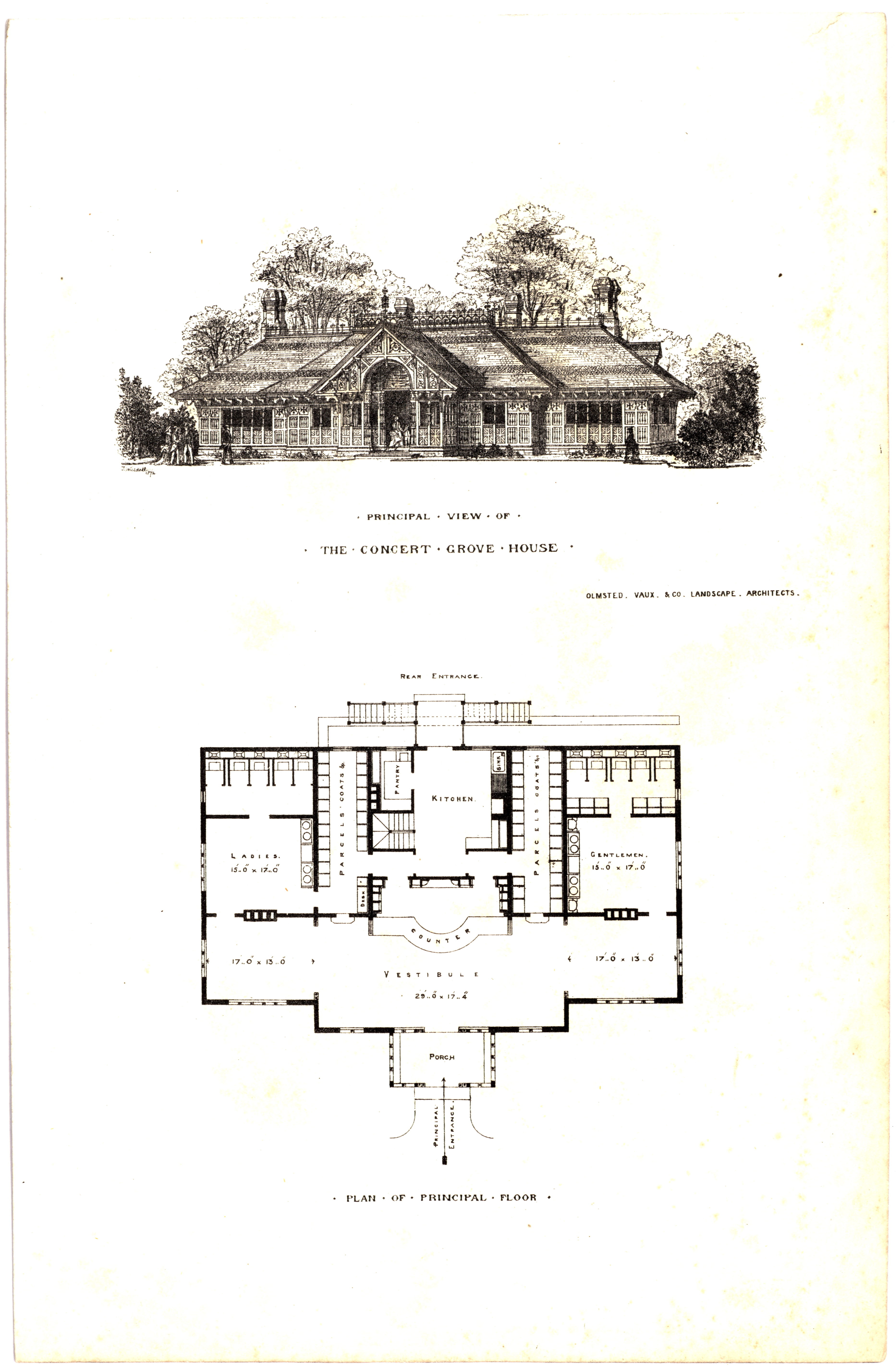
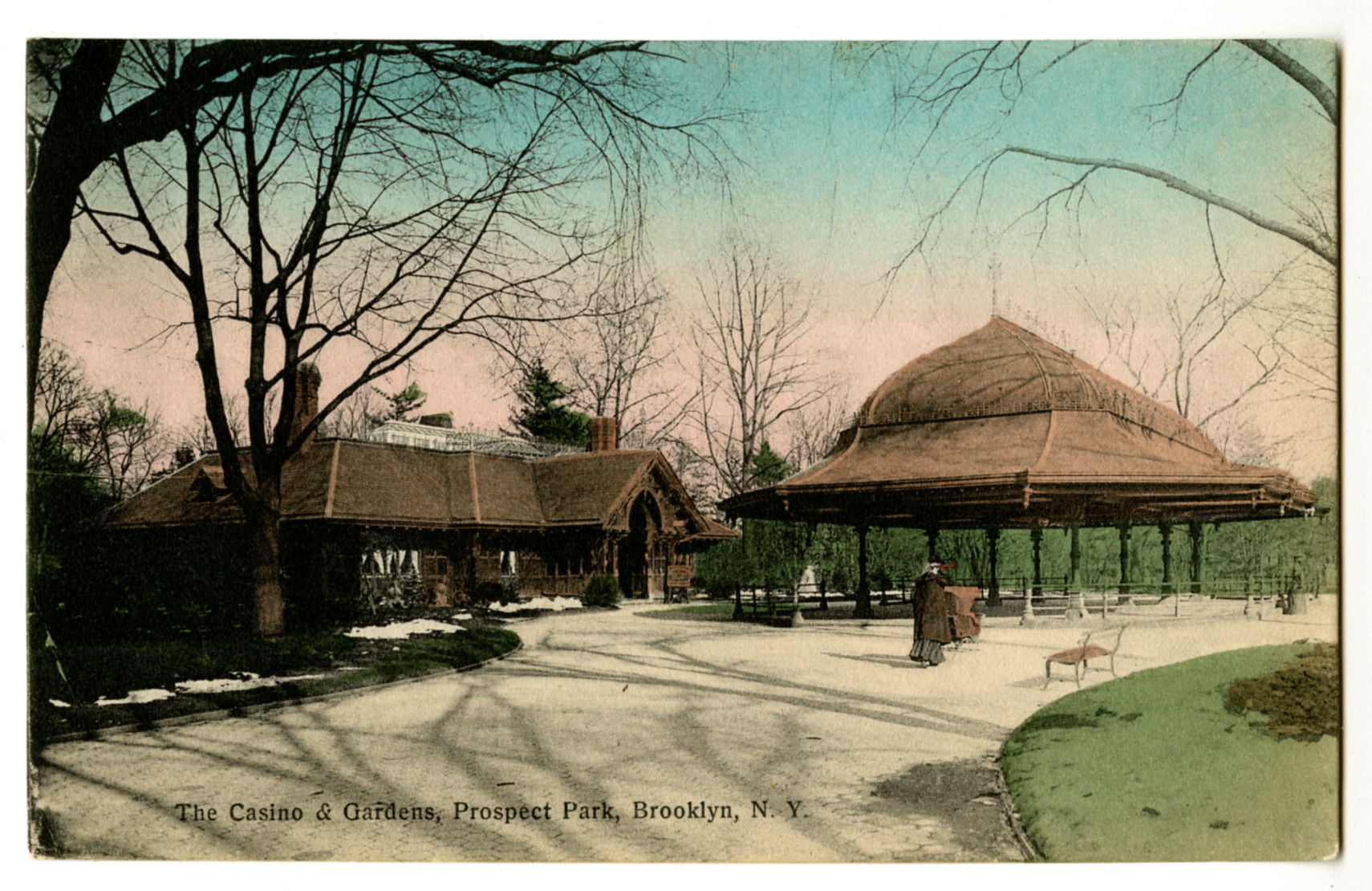
Concert Grove and Concert Grove House proved to be quite popular with non-fictional individuals as well. Free live music and cheap treats are a draw in any era. In 1874 the Concert Grove Pavilion was added, serving as an outdoor seating area for diners. Olmsted and Vaux, inspired by trips to European parks, created the Grove as an experience that could be enjoyed by attentive audiences, and those just dropping in for a song or a sandwich. Even the neighboring carriage concourse was designed with space to allow carriages to pause for a listen.
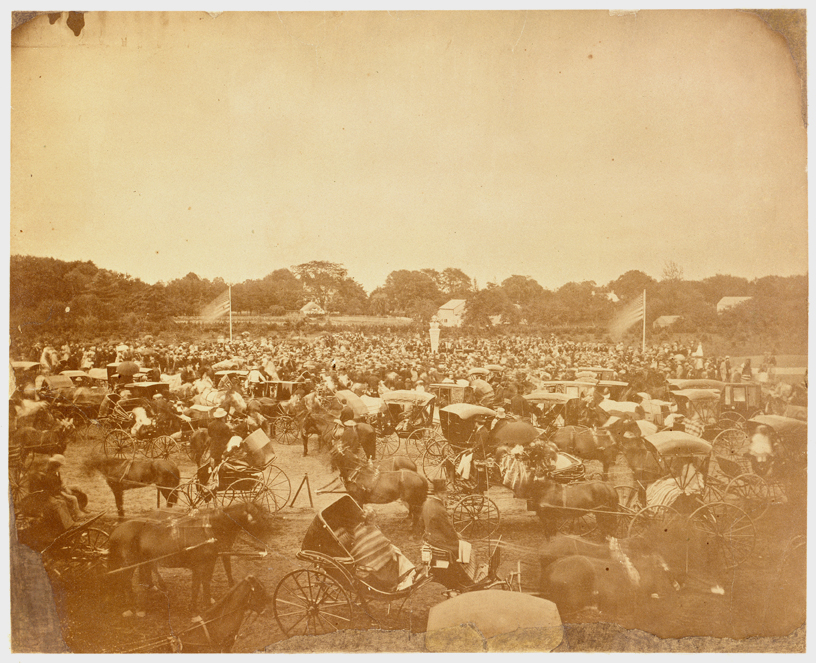
In 1877, an article ran in the Brooklyn Eagle capturing the grove’s popularity:
Several thousand people yesterday afternoon enjoyed the delicious breeze which was to be obtained in Concert Grove at Prospect Park…At four o’clock Conterno’s Band of thirty pieces made its appearance [on Music Island]...All around the music stand every available seat or resting spot was eagerly taken possession of, and the perspiring multitude listened to the sweet strains of Wagner, Weber, Beethoven, Strauss and the rest of the composers from whose studies Mr. Conterno makes such a judicious selection every Saturday. Yesterday’s open air concert was the second of the season, and the immense crowd which assembled to attend it proved that the idea has not only been a success, but is really a public boon.
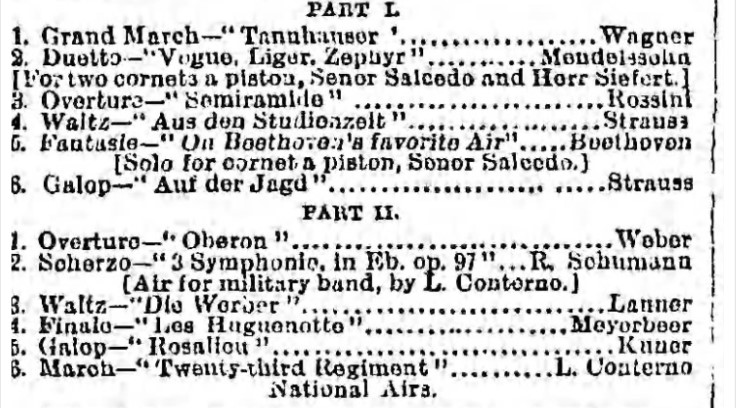
Though the promotional Alice touted Concert Grove House’s temperance bar (which served non-alcoholic drinks, such as sodas), the bar was a bit less dry by 1877. The same article highlighted “THE SALE OF LAGER AT THE SHELTER,” saying, “nearly all the male visitors at the Park imbibed, and not a few of the ladies followed their example.” Throughout the day, grove visitors played croquet until it was too dark to see the wickets, crammed 10-12 people into rented boats on the lake, raced miniature yachts, and circled carriages “listlessly” around the grove as they listened to the music. As the Brooklyn Eagle put it, “These Saturday concerts have already become fixed in the public mind, and are looked forward to with pleasure by all classes.”
Concert Grove was a hit! So, what happened? Why did Music Island stop hosting concerts? Where did Concert Grove House go? While Olmsted and Vaux endeavored to control every aspect of the park experience, one detail they failed to fully harness was sound. As enjoyable as Concert Grove was purported to be, the acoustics of Music Island were less than ideal. The concerts were held inside a temporary wooden bandstand, rebuilt on the island annually, that offered minimal to no acoustical support, and the quality of the music was diminished as it traveled across the water toward the Concert Grove House. So, in effort to improve the auditory experience, the concerts were relocated in 1887 to Music Grove in the Nethermead, specifically to the still-standing Music Pagoda.
The Music Pagoda was inspired by the unusual combination of ancient Chinese city gateways (on the top) and military fortifications (on the bottom), and was built using stones from a Battle of Brooklyn site. While the top half of the pagoda may vaguely resemble the Concert Grove Pavilion, it is actually the oldest surviving park structure not designed by Olmsted and Vaux (creator unknown). The pagoda also housed lockers on its lower level for the tennis players that once flocked to the Nethermead just outside of Music Grove. The grove itself consists only of the immediate area surrounding the pagoda, where long benches were originally arrayed. With its improved acoustics, Music Grove became the new destination for free concerts, and would remain so for decades to come. Brooklynites sang along to “Let Me Call You Sweetheart” through an air raid drill during one of the many free concerts offered through World War II. Other performances frequently included Edwin Franko Goldman and the Goldman Band. In the 1960s, theatrical performances were added to the list of events, and the pagoda served as the site for various historical moments, including the park’s 100th anniversary. Pagoda affairs were brought to a sudden halt when it burned down to its stone foundation in 1968, but it was rebuilt three years later and quickly became the site for Vietnam War protests.
In 1939, another concert venue was erected under Park Commissioner Robert Moses’ instruction: the Bandshell, designed by Aymar Embury and funded by the WPA. Benny Goodman and Cab Calloway played at the bandshell in the 1940s and ‘50s, when swing dancing swept the nation, but it fell into disuse in the 1960s, while the Music Pagoda reigned as the supreme concert venue. However, in 1979, the bandshell and free park concerts at large were reborn with the launch of the first Celebrate Brooklyn Performing Arts Festival, now BRIC Celebrate Brooklyn. The tradition has continued ever since and the bandshell is home to the longest running free summer concert series in New York City. In 2021, the bandshell was renamed the Lena Horne Bandshell, in honor of the legendary Bed-Stuy-born singer, actress, dancer, and civil rights activist.
Back at Concert Grove, following the concerts' relocation in 1887, the area was transformed, for a time, into the Flower Garden or Rose Garden. Even without the music, Concert Grove House and Pavilion continued to operate much as they always had for decades.
Leaping ahead to 1949, Robert Moses tore down Concert Grove House as part of a park redesign, which included the installation of a snack bar in the pavilion. The snack bar served general park goers as well as skaters visiting Moses’ Wollman Rink, which was built in the 1960s where the LeFrak Center stands today. In 1974, the Concert Grove Pavilion was almost completely destroyed in a fire caused by the snack bar; only the cast iron legs remained. Fortunately, it was rebuilt in 1988, sans snack bar. In 2021, the pavilion underwent a much needed restoration, which included restoring "elaborately detailed wooden trim and moldings" and lighting the star-patterned stained-glass ceiling at the pavilion’s center. Appreciated as one of the park’s remaining original structures, the pavilion is often chosen as the site for park weddings. Though it is the last element added to Concert Grove's original concept, it is the most iconic remaining feature of Olmsted and Vaux's vision.
Today, Music Island is purposely unused, intended as a natural habitat for the park's flora and fauna. Weekly performances have never returned to Concert Grove, but the original intention of free park concerts has endured across 150 years. As the venues have changed, so too have Brooklynite's musical tastes. BRIC Celebrate Brooklyn describes the most recent (2025) concert series as one that honors “diverse cultures that make Brooklyn a global music hub, featuring artists whose work transcends borders and celebrates the exchange of ideas.” Whether dancing near the stage or picnicking outside the bandshell, reclining in Music Grove or boating by Music Island, Prospect Park and free concerts continue to be a successful match. The only thing missing? An enchanting dining establishment providing a place to sit and enjoy that "plain sandwich" and "finest ice cream, at very reasonable prices" as the music plays on.
Special thanks to Amy Peck, Prospect Park Archivist.
This blog post reflects the opinions of the author and does not necessarily represent the views of Brooklyn Public Library.
Post a Comment
While BPL encourages an open forum, posts and comments are moderated by library staff. BPL reserves the right, within its sole discretion, not to post and to remove submissions or comments that are unlawful or violate this policy. While comments will not be edited by BPL personnel, a comment may be deleted if it violates our comment policy.
eNews Signup
Get the latest updates from BPL and be the first to know about new programs, author talks, exciting events and opportunities to support your local library.