Central Library, 2nd floor Balcony Cases
This exhibition has been extended and will now be open until June 20th, 2026. However, in observance of Juneteenth holiday, June 18th will be the last full day to see the show.
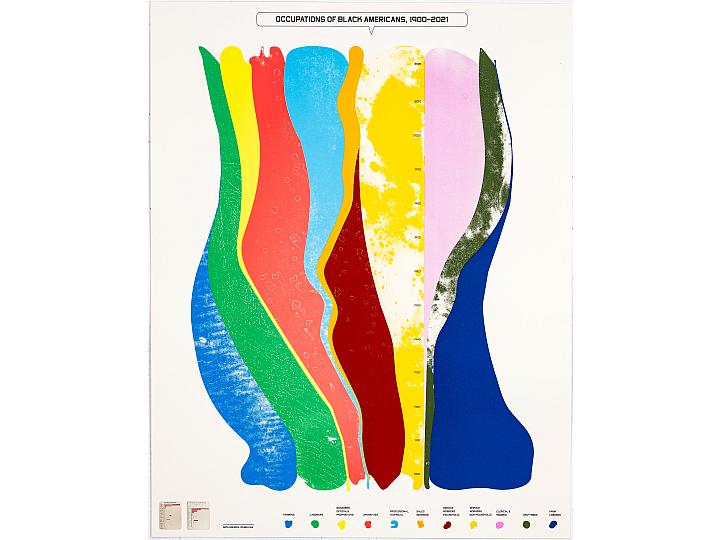
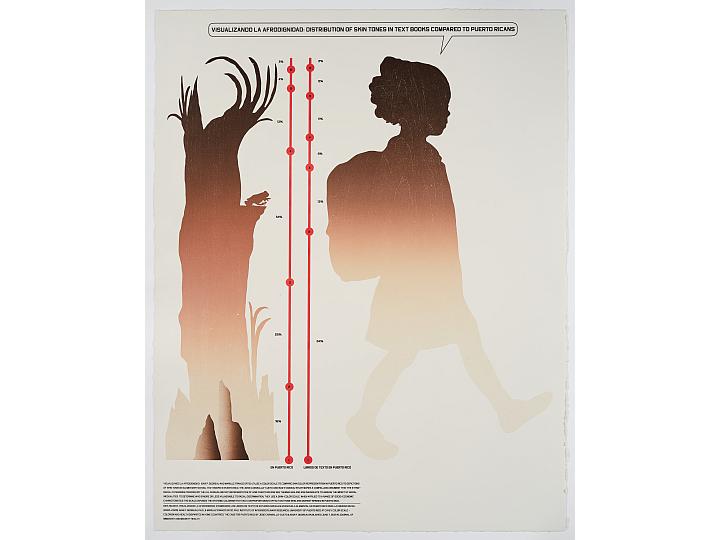
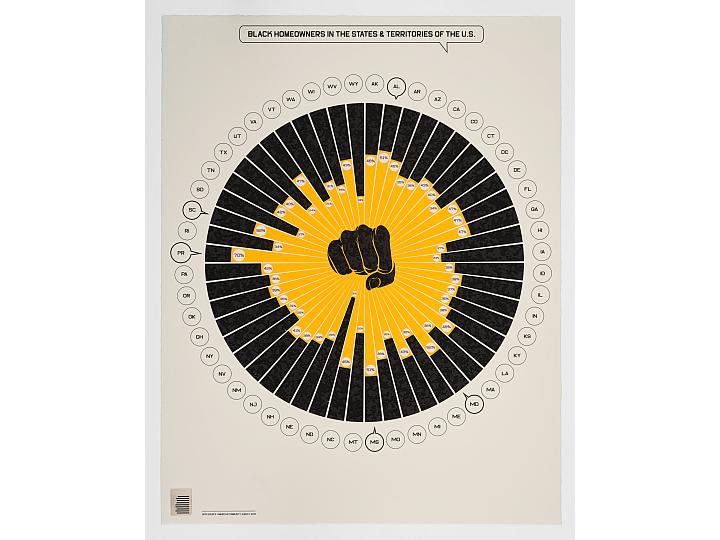
Printing Black America is a responsive, transhistorical project that portrays aspects of Black life in the 21st Century. Urbanist Shraddha Ramani and visual artist William Villalongo reinterpret and respond to the data visualizations innovated by luminary activist and educator W.E.B. Du Bois—what he called “data portraits”—that debuted among a collection of materials at the 1900 Paris World’s Fair in “The American Negro Exhibition” (ANE). One hundred and twenty-five years later, Ramani and Villalongo expand on Du Bois’s methodologies of data collection and visual storytelling, centering “living projects” in local communities across the country to consider new possibilities for Black life today and to probe at the meaning of these historical works when held up against our contemporary moment.
This exhibition shows historical source material alongside the contemporary works of Printing Black America. An installation in the Languages and Literature wing delves into The American Negro Exhibition (sometimes referred to as the Exhibit of American Negroes) in the 1900 Paris World’s Fair, offering important context. It was co-organized by a collective of leading African American scholars, activists, and human rights advocates: Thomas J. Calloway (leading the project; a lawyer and principal fundraiser for the exhibit), Daniel A.P. Murray (the Assistant Librarian of Congress), and W.E.B. Du Bois. This grand prize-winning exhibition offered a powerful encapsulation of Black progress despite structural oppression and a counter-narrative against the mainstream ideology of racism, celebrating Black life and achievement in America’s post-Reconstruction era.
Importantly, Printing Black America employs the same means of mechanical reproduction in image-making—printmaking—used in Du Bois’s era, using various fine art printing techniques to create vivid imagery. It was editioned across a national network of printshops, from Graphicstudio in Tampa to Highpoint Center in Minneapolis, Island Press in St. Louis to Mullowney Printing in Portland, Paulson-Fontaine in San Francisco to Powerhouse Arts in Brooklyn.
The celebration of Black people, culture, and life was central to Du Bois’s work. It is central, too, to Printing Black America. Like Du Bois’s incisive inquiries, his demographic methodologies, and his fight for civil rights, Printing Black America offers far more than a reinscription of the issue Du Bois named in his 1903 masterpiece, The Souls of Black Folk, as the defining problem of the 20th century: the problem of the color line. Like its source, Printing Black America gives visibility to the shapes of collective, creative resistance, and to Black joy, dignity and continued self-determination.
REGISTER HERE for the Opening Event on March 2, 6:30-8:30pm at Central Library, Grand Lobby.
Exhibition Brochure
Preview the Exhibit
Printing Black America: Du Bois’s Data Portraits in the 21st Century is organized by Cora Fisher, BPL Curator of Visual Art, BPL Presents, with William Villalongo and Shraddha Ramani. Exhibition essay contributions by Karole Dill Barkley, Stephanie Dinkins, Dominique Jean-Louis, Public Historian at the Center for Brooklyn History, and Corey D.B. Walker, Wake Forest University Dean, School of Divinity, Professor of the Humanities and Director, Program in African American Studies. Karole Dill Barkley is Curatorial Researcher and contributor to the section on The American Negro Exhibition on view in Central Library’s Languages & Literature.
Special thanks to Susan Inglett Gallery, Print Center New York, and all who contributed, including BPL Staff.
Printing Black America is funded in part by the Katowitz-Radin Endowment.