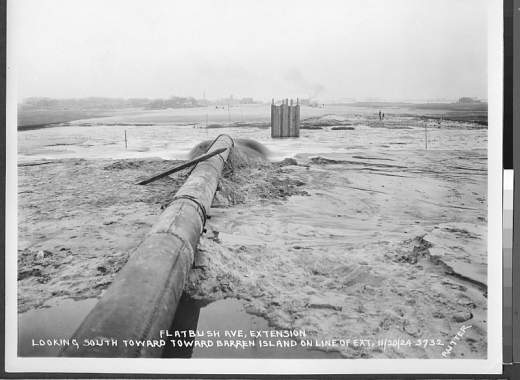
RUTT_0085, Flatbush Ave. Extension, 1924, Edgar E. Rutter Photograph Collection,
Center for Brooklyn History, Brooklyn Public Library
It's difficult to picture from where we're standing, but until the 1920s, significant portions of southern Brooklyn were still farmland. This week's Photo of the Week comes from Edgar E. Rutter (1883-1956), a commercial photographer who was employed by the New York State Public Service Commission and various other state and city agencies to photograph the sites of proposed construction projects in Brooklyn and…
[Cuyler Presbyterian Church] , CHUR_0529. Brooklyn Daily Eagle photographs, Brooklyn Public Library, Center for Brooklyn History.
Today's Photo of the Week takes us to Boerum Hill, where residents of the Kahnewake Mohawk territory near Montreal, Canada, settled in the early and mid-20th century. The Mohawk are one of six nations that belong to the Haudenosaunee, also known as the Iroquois Nation. The large number of Kahnewake Mohawks who resided in this section of Brooklyn while pursuing economic opportunities in New York City earned the area the…
Litchfield Villa, HERZ_0213. Irving I. Herzberg photograph collection, Brooklyn Public Library, Center for Brooklyn History
Each day on my walk to work I pass the Litchfield Villa, admire it for its Italianate style architecture, glance at the dance class that is usually taking place on the front lawn and continue on my way. It was designed and built in 1854 by Alexander Jackson Davis, a prominent architect for Edwin Clark Litchfield, a railroad and real estate developer. He's the one who turned a small creek into Gowanus…
Courage of a soldier by Mavis John. 2014. VETS_379. New York Harbor Hospital Creative Arts Program Collection, Brooklyn Public Library, Center for Brooklyn History
New York City is host to art programs for diverse populations offered in a range of venues: museums, schools, libraries, cultural institutions and hospitals. It is rare to get a glimpse of artworks made by veterans of military service.
From 2008-2017 the Veterans Creative Arts Program, hosted at the Veterans Affairs (VA) New York Harbor Hospital, Brooklyn Campus, offered…
Kimberly McEwen, 1971, color photograph. Brooklyn Heights Garden Club collection, BCMS.0082. Brooklyn Public Library, Center for Brooklyn History.
I recently finished processing the Brooklyn Heights Garden Club collection, which chronicles the club's history through documents, ephemera, clippings, and scrapbooks. The club was founded in 1940 by Mrs. Thomas Sturgis to "bring added beauty to Brooklyn Heights by the creation and cultivation of gardens, plantings and window boxes." In 1949, the club started organizing an annual…
George Bradford Brainerd, [The soap fat man], 1870s, glass plate negative. George Bradford Brainerd photograph collection, BRAI_0234. Brooklyn Public Library, Center for Brooklyn History.
Soap making during the 1800s was dirty business. It required two key ingredients: rendered animal fat and lye, a caustic substance traditionally made from wood ashes. Before industrialization, many Brooklynites made their own soap using accumulated cooking fat and grease from the home. The final product, known as soft soap, was stored in barrels and used…
Isaac and Esther Ramus around 1855. bhs_v1978.174.38. Ramus family papers and photographs, Brooklyn Public Library, Center for Brooklyn History.
The first set of photographs originating from the former Brooklyn Historical Society to be featured in the Center for Brooklyn History digital portal is the Ramus family collection.
It is a tantalizing set of images rich in examples of fashionable dress between 1848 and 1910 and a variety of photographic techniques including daguerreotypes, tintypes,…
[Women working in the Eberhard Faber pencil factory], circa 1915, V1988.35.6, Brooklyn Public Library, Center for Brooklyn History.
As New York City students return to the classroom, we’re dreaming of fresh school supplies. Notebooks, rulers, folders, and of course: pencils. Were you the kid who always had two freshly sharpened pencils ready to go at a moment’s notice? Were you the monster who borrowed a pencil and never returned it? Either way, there’s a good chance you've used a Faber pencil.
The Faber family started manufacturing pencils in Germany…
F. & M. Schaefer Brewing Company, June 21, 1949, Brooklyn Daily Eagle Photos,
Center for Brooklyn History, Brooklyn Public Library
On April 1, 1949, the Brooklyn Daily Eagle was full of news of workers on strike. The headline for the day announced that a taxi strike was on and "90% tied up," meaning that all but 701 of the city's 11,510 taxicabs had refused to start their engines. Meanwhile, CIO radio operators at Pan-American Airways had launched a strike over deadlocked contract negotiations, and in a slim article further down the page, readers…
Federal naturalization record for Nejib Ibrahim Katibah, 1912. Ancestry.com.
Family history research is one of the Center for Brooklyn History's most popular research topics. Millions of people can trace their roots back to Brooklyn. Yet despite an abundance of resources available at CBH, piecing together the social history of one's ancestors--or anyone for that matter--can be difficult, exhausting, and full of dead ends. Several months ago, I ran across the name of a young dentist (and poet) in The Brooklyn Daily Eagle who emigrated to…
[Inman's Casino], 1946, CONE_0451. Brooklyn Daily Eagle photographs.
Brooklyn Public Library, Center for Brooklyn History.ption
This week's photo is of Inman's Casino, which was located on the Bowery of Coney Island. The Bowery was south of Surf Avenue and ran from Jones Walk to West 16th Street on the east side of Steeplechase Park. Its main drag, known as Ocean Avenue until around 1905 and as Bowery Lane thereafter, ran parallel to Surf Ocean.
The Vaudeville opened prior to 1900, and claimed to cater to women and children. But if this…
[Flood at Sutter and Saratoga Avenues], 1923, NEIG_0291. Brooklyn Daily Eagle photographs. Brooklyn Public Library, Center for Brooklyn History.
This week's Photo of the Week takes us to the intersection of Sutter and Saratoga Avenues in Brownsville in July 1923, when severe storms turned the borough's streets into rivers, flooded subway stations and basements, and caused guysers to erupt from manhole covers. Lightning blasted apart wood paving blocks on Cortelyou Road in Flatbush, threw a construction worker from his ladder on Ocean…
[Children riding to school in pony cart], circa 1947. Kasper Family Collection, BCMS.0080. Brooklyn Public Library, Center for Brooklyn History.
Today's photo of the week comes from the recently processed Kasper Family Collection. The Kasper family lived at the Manhattan Beach Veterans Housing Project in South Brooklyn in the late 1940s. The Manhattan Beach project was one of many veterans housing projects that the city created in the late 1940s to respond to a surge in demand as soldiers returned from overseas. As this 2011 Brooklynology blog…
Solution of the tenement problem: Riverside Building, the Quadrangle, 1892. WILC_0320, Julius Wilcox photograph collection, Center for Brooklyn History.
In the late 19th century housing conditions for the poor in Brooklyn were crowded, unsafe, poorly ventilated, and lacked amenities. Today's Photo of the Week shows one of the first efforts in our borough to create affordable and pleasant housing for those who struggled to pay the rent.
The cyanotype above…
[Ice Delivery from the American Ice Company to Emmanuel House], circa 1910, lantern slide, V1981.284.12. Emmanuel House lantern slide collection, ARC.138. Brooklyn Public Library, Center for Brooklyn History.
For non-native New Yorkers like myself, surviving the hot, humid days of summer feels like an annual badge of pride. Grabbing a popsicle from the freezer or an ice cream cone from the neighborhood creamery has long been a favorite way to beat the heat. Today, most Brooklynites take access to cold and frozen food for…
Every year, the National History Day contest provides students with an opportunity to dive into research related to an overall theme and present their findings in a variety of formats at their regional contest. We’re thrilled to host the regional contest for New York City at the Center for Brooklyn History in the 2021-22 school year, and we’ve been using the summer break to brainstorm some of our favorite topics related to this year’s contest theme.
This year’s theme is Debate & Diplomacy in History: Successes, Failures, Consequences. You can read more about the theme at nhd.org/theme.…
Brooklyn Eagle postcard collection, [Knox Hat factory, St. Marks and Grand Avenues], circa 1905, POST_0558, Brooklyn Public Library, Center for Brooklyn History.
Today we're looking at the imposing apartment building at 369-413 St. Marks Avenue that began life as the world’s largest hat factory. Founded by Irish immigrant Charles Knox, the Knox Hat Company began operations in lower Manhattan, selling beaver hats in a small store he opened in 1838. Through promotion and word of mouth, the business built an impressive clientele, including Abraham…
[Rendering of Steve Brodie (1863-1901) who jumped from the Brooklyn Bridge, and survived, on July 23, 1886. Image includes a portion of the East River and four small boats.] 1886. Brooklyn Daily Eagle photographs, Brooklyn Public Library, Center for Brooklyn History
This is a rendering of Steve Brodie a resident of Manhattan and former newsboy who claimed to have jumped from the Brooklyn Bridge and lived. The bridge, then called the East River Bridge had just recently been completed in 1883 and on July 23, 1886, Brodie took the plunge.
Or did he?
The…
GEAT_0002, Anthony Geathers Photograph Collection, Center for Brooklyn History, Brooklyn Public Library
This week's Photo of the Week is a call to action. Did you know that one facet of Brooklyn Resists is a community collecting initiative? We invite you to share your thoughts, experiences, and digitized personal artifacts as part of the Brooklyn Resists community collecting project. Learn more about what this entails and read our statement of purpose and guidelines here.
Our ultimate goal is to provide…
Brooklyn Connections is a program run by the Center for Brooklyn History’s education department that cultivates 21st Century learning skills in students and supports teachers with the incorporation of archives materials into curricula. Click here to view a selection of this year's Brooklyn Connections final projects.
The Othmer Library at the Center for Brooklyn History
Has gentrification affected the lives of immigrants in Brooklyn? How did Coney Island become the destination it is today? If you could…
[Sidewalk conditions on southeast corner of Pearl and Willoughby Streets looking south from roadway of Willoughby St], 1915. Subway Construction Photographs, Brooklyn Public Library, Center for Brooklyn History.
One of the most frequent challenges for staff and researchers in CBH's Othmer Library is finding photographs that provide evidence of Brooklyn's past built environment. The city's 1940 tax photos are our go-to resource, but these can miss houses, businesses, and community landmarks that were razed in earlier years.
For some…
[Hotel St. George pool], 1930. Photographs from the Brooklyn Daily Eagle, NEIG_1455. Brooklyn Public Library, Center for Brooklyn History.
As a summer heat wave kicks off the last few days of Pride Month, our Photo of the Week takes us to an elegant indoor pool at the Hotel St. George in Brooklyn Heights.
The Hotel St. George was once the city's largest hotel and a glamorous spot to see and be seen. It was also a known cruising and gathering space for gay men, some of whom resided at the hotel. As such, it has been featured in two of…
Brooklyn Borough Hall murals, circa 1939. Edgar E. Rutter photograph collections, RUTT_0001. Brooklyn Public Library, Center for Brooklyn History.
This week's POTW takes us inside the office of the new incoming Brooklyn Borough President as New Yorkers get ready to vote in the June 22 primary election. Borough Hall, originally City Hall, is located in the heart of downtown Brooklyn and is one of the borough's oldest public buildings. It was also home to two highly contentious 900 square foot murals, whose final fate remains unknown today.…
Requiescat in pace--No tears were shed for the passing of the Fulton St. L today, but Masur, the florist on lower Fulton St., rushed out with a wreath to hang on the elevated pillar in front of his shop [with sign, "Funeral services May 31, 1940 of the dirty elevated, undertaker, Mr. Storekeeper of Fulton St."] as a final touching tribute. TRAN_0262, Brooklyn Daily Eagle photographs, Center for Brooklyn History
In search of something wholly unrelated, I fell upon the mischievous photograph above from the Eagle commemorating the final run of the…
Marie Roberts Dreamland Circus side show photographs, CONE_0590, c1924, Center for Brooklyn History, Brooklyn Public Library.
Stephan Bibrowski (1890–1932), also known as "Lionel the Lion-Faced Man," was born outside Warsaw, Poland with a rare condition called hypertrichosis. Often called “werewolf syndrome” hypertrichosis causes excessive hair growth on the body and is now thought to be hereditary. While Stephan’s mother was pregnant with him she watched as his father was attacked by a lion, an event she believed caused Stephen’s condition.
At four…
When the Scientific American offered a $2500 prize to anyone who could produce a visible psychic manifestation, Chicago medium Elizabeth Allen Tomson answered the call. In the Fall of 1923 she arrived in New York with her husband and spokesman, Dr. Clarence Tomson and their daughter. Tomson performed several seances in homes across the city, using a technique that involved her entering a large cabinet where she fell into a trance and manifested spirits of the dead.
The Chat, November 29, 1924
One attendee not impressed with Tomson’s spiritual…
To close out National Bicycle Month, here's a little a celebration of bicycling in Brooklyn, from 1897 to the present.
POST_0143, Music Island, Prospect Park, Brooklyn, N.Y., summer circa 1897,
Brooklyn Postcard Collection, Center for Brooklyn History
Even now, in the 21st century, I feel a powerful sense of freedom, exhilaration, and agency whenever I'm riding my bicycle around Brooklyn. It must have been truly extraordinary for women in the 19th century, who were newly admitted to the ranks of "wheel riders" in the 1890s. At the time, Brooklyn…
[Brooklyn Central Library, Flatbush Avenue and Eastern Parkway; Alfted Morton Githens, Francis Keally, Associated Architects], CBPL_0004, 1938; Roy Pinney photographs; Brooklyn Public Library, Center for Brooklyn History.
Recently the Central Library of the Brooklyn Public Library had a ribbon cutting ceremony for the completion of Phase One of a multi-phase renovation project. This phase returns space formerly used for administrative needs back to the public and creates five grand spaces: the Major Owens Welcome Center, New and…
[Brooklyn Navy Yard Buildings], NEIG_1249, 1908; Brooklyn Daily Eagle photographs; Brooklyn Public Library, Center for Brooklyn History.
Today's photo of the week takes us to the corner of Sands and Navy Streets in Vinegar Hill, a section of Downtown Brooklyn adjacent to the Navy Yard. While the neighborhood was named for the final battle of the Irish Rebellion of 1798, reflecting the large Irish population who settled here in the early to mid-1800s, people of all backgrounds resided in Vinegar Hill's densely-built streets. The…
The Gottlieb family. Mother holding baby girl in an urban park on the Lower East Side. BJHP_0173, 1947; Brooklyn Jewish History Project, Brooklyn Public Library, Center for Brooklyn History
This is a photo of Regina (Rivka, nee Kanner) Gottlieb and her daughter Madeline in a park on the Lower East Side in 1947. The joy on both of their faces is palpable, despite the difficult years that preceded this photo. Regina and her husband Alexander were both from Poland, Alexander from Borislaw and Regina from Lodz Ghetto. They had both survived …
Representing Brooklyn
From his roots as a librarian here at Brooklyn Public Library, to his ascent to the New York State Senate and U.S. House of Representatives, Major Owens' legacy is defined by his work as a tireless antipoverty reformer and as an advocate for education, civil rights, Americans with disabilities, workers' rights, and immigrants. As Brooklyn Public Library cautiously opens the doors to Central Library and a handful of other branches a little further this month, we are also unveiling renovations and improvements that have taken place during our…
[Four people and a field of sheep], circa 1890, arc.202_box17_112; Brooklyn photograph and illustration collection, ARC.202; Center for Brooklyn History, Brooklyn Public Library.
Spring in Brooklyn is often fleeting, lasting a month or two at most. With it brings relief from winter’s harsh weather, blooming flowers, and tepid evening breezes. In the late nineteenth and early twentieth century, spring also marked the return of sheep to Prospect Park. Every April, a large flock of Southdown, a breed known for its adaptability and good lambing…
Loew's Pitkin Theater, 1958. NEIG_0227, Brooklyn Daily Eagle photographs, Center for Brooklyn History
Today’s Photo of the Week features a busy corner in Brownsville, 1501 Pitkin Avenue, where the stately Loew’s Pitkin Theater took up the entirety of the block between Legion Street and Saratoga Avenue. I was drawn to the building by this snapshot showing the random composition and distinctive pinked edges of mid-century candid photography, with the huge structure looming over a…
Old Tower House, NEIG_1696, 1910; Brooklyn Daily Eagle photographs; Brooklyn Public Library, Center for Brooklyn History.
Today’s photo of the week takes us to Park Slope, where a residence locally known as "the old tower house” once stood on the south side of 8th street between 5th and 6th avenues. The Brooklyn Daily Eagle published the above photograph of the old tower house in 1910, two years after the death of the building’s longtime owner, Asa B. Richardson. The Eagle claimed at the time that the…
WILC_0085, 1892, Center for Brooklyn History, Brooklyn Public Library
Today's Photo of the Week is a cyanotype created by New York City photographer Julius Wilcox. Wilcox was born in Vermont in 1837, moving to New York at the age of 29 and settling in Brooklyn. He made his living as a writer for the New York Evening Gazette and as part owner of a bicycle business. He seems to have taken up photography as a hobby, photographing mostly in Manhattan, favoring architecture and the city’s working-class and poor. His album of original cyanotypes with…
BPL_0002, 1951, Brooklyn Daily Eagle Photograph Collection,
Center for Brooklyn History, Brooklyn Public Library
This week is American Library Association's National Library Week, a time to celebrate library workers and outreach efforts, and promote library use and support. Wednesday, April 7th is National Library Outreach Day or the Day Formerly Known as Bookmobile Day.
The bookmobile pictured above dates back to BPL's outreach efforts in the 1950s, a beauty known as the "Library on Wheels." The borough's first, its maiden voyage was in October 1951…
[Opening game of the World Series], DODG_0002, 1947; Brooklyn Daily Eagle Photographs, Brooklyn Public Library, Center for Brooklyn History
It's been a strange long year and something like the start of baseball seems even stranger in our current climate. Fields and stadiums are opening slowly with limited entry and required vaccination cards. But back in 1947 all you needed to see a game was a ticket and some excitement. This is a shot of fans from Game 1 of the World Series pitting the New York Yankees against Brooklyn's own beloved Dodgers. 73,365…
[The Folly], THEA_0027, 1906; Brooklyn Daily Eagle photographs; Brooklyn Public Library, Center for Brooklyn History.
To celebrate the announcement in the beginning of March that theaters will reopen in April, our photo of the week takes us to the corner of Graham Avenue and Debevoise Street in Williamsburg.
This corner was the location of the Folly Theater which opened on the afternoon of October 14, 1901. The Folly was owned by Richard Hyde who -- according to the Brooklyn Daily Eagle --…
[Former Joseph Wild & Co factory, 218 Kosciusko Street in Bedford-Stuyvesant], circa 1935; Bommer family collection, 1992.033, Box A0142; Center for Brooklyn History.
This week’s Photo of the Week takes us to Kosciusko Street in Bedford-Stuyvesant, on the block that forms the northern boundary of Herbert Von King Park (known in the 19th century as Tompkins Park).
[Former Joseph Wild & Co building, 196 Kosciusko Street in
Bedford-Stuyvesant], circa 1935; Bommer family
collection, 1992.033, Box A0142; Center for…
Photo of Neighbors Against Garbage (N.A.G.) litter cleanup, GEHP_0193, c. 1990s; Greenpoint Environmental History Project; Brooklyn Public Library, Center for Brooklyn History.
In the early 1990s, residents of Greenpoint and Williamsburg were fed up with the city neglecting their neighborhoods. A number of grassroots community organizations sprang up in response to various issues, including development, community board planning processes, and excessive litter. One such organization was Neighbors Against Garbage (N.A.G.), founded in 1994 in a local…
Fulton Ferry House, [190-?] TRAN_0364, Brooklyn Daily Eagle photographs, Center for Brooklyn History
Our photo of the week features the Fulton Ferry House that once stood where Old Fulton Street met the water’s edge in Brooklyn Heights, one in a series of ferry buildings on that site. One of the handsomest depictions of this building is paired in the Eagle photographs with an earlier Brooklyn ferry house, built sometime before 1746. The early view is adapted from an engraving in Stiles’ … history … of Brooklyn, N. Y. from 1683 to 1884. Stiles is…
Did you know that Brooklyn Public Library has a web archive? In 2017, the Brooklyn Collection (now part of the new Center for Brooklyn History) joined the Internet Archive’s Community Webs program, in which public libraries around the country are given the funding and support to start and sustain web archives. We have been archiving Brooklyn web content through this program for over three years now.
Web archiving is how we describe the process by which we save and preserve websites and web content in a stable and static archival format. This is…
[Interior of the Slave Theater], Hiroki Kobayashi, circa 2010;
Hiroki Kobayashi photographs on the Slave Theater from
the collection of Dexter Wimberly, 2014.023;
Brooklyn Public Library, Center for Brooklyn History.
Black historical sites are rapidly disappearing across Brooklyn despite efforts by local activists and preservationists. The destruction of these tangible sites of memory--largely as a result of redevelopment and gentrification--impacts the way we remember, understand, and tell history. The recent demolition of the Slave Theater in Bedford-…
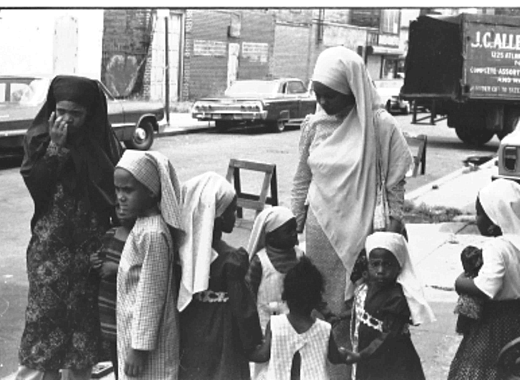
Khalil Abdulkhabir, Young Girls and Teachers at the Yasin Mosque,
circa 1975, 2020.002.005; Khalil Abdulkhabir photographs of the Dar-ul-Islam movement,
2020.002, Center for Brooklyn History.
The Dar-ul-Islam, known as "the Dar," was one of the most significant grassroots movements established by African-American Sunni Muslims in the United States. The founding members of the Dar-ul-Islam came from the Islamic Mission of America, founded in 1939 by Daoud Ahmed Faisal and Sayedah Khadijah Faisal, at 143 State Street (the “State Street Mosque”). In 1962-1963…
Before Shirley Chisholm or David Dinkins made history, Bertram L. Baker paved the way. If you've found yourself on Jefferson Avenue between Tompkins and Throop Avenues, you may have noticed street signs announcing his name. The first Black elected official from Brooklyn, Bertram L. Baker made his debut in the New York State Assembly in November 1948, where he would serve for the next twenty-two years. It was a milestone in Brooklyn history, but do you know his story, or what politics in the borough looked like when he was elected?
PORT_0043,…
A few years ago, I went in search of background information about a periodical in the Center for Brooklyn History collections called Afro-America. It was published in the late 1960s from Fred Richardson’s African American Bookstore in Crown Heights, which sold books by and about Black writers, poets, and political leaders, as well as picture books for children and art by Black artists. Fred opened the store when he was just 22.
Fred Richardson in his newly opened store with sculptor Ruth Inge Hardison. New Amsterdam News, Brooklyn Edition, December 12, 1964…
J. S. Johnston, Life Saving Station, Manhattan Beach, Coney Island, N.Y., c. 1894, v1972.1.557; Brooklyn Public Library, Center for Brooklyn History. This week's photo takes us to the lost eastern end of Manhattan Beach.Manhattan Beach, on the eastern end of Coney Island, was the brainchild of robber baron Austin Corbin. In the 1870s, he bought 500 acres here and erected two luxury resort hotels for vacationing New Yorkers (not all New Yorkers, however, as Corbin was a notorious anti-semite who barred Jews from the resort). He also built the New York and Manhattan Beach…
Larry Racioppo, New Year's Day dinner toast, 6th Avenue, 1977, RCPO_0005; Brooklyn Public Library, Center for Brooklyn History.
Family history, memory, and tradition abound in the work of Larry Racioppo, including this evocative and joyful image of a family New Year's Day toast.Photographer Larry Racioppo grew up in a large Italian-American family in Brooklyn, and his family has always been well-represented in his work. We hold a collection documenting his work and career, and many of the photographs from the collection are…
The teenage years are a difficult time, with emotions running high and relationships with the people in your life changing quickly. Poetry is a universal outlet for teens to explore feelings about themselves and their world. While most poems stay tucked away in journals or at the bottom of trash cans, some brave souls are eager to share. Before social media, publication in a school newspaper was one of the most direct ways for a poet to reach their peers. We combed through our Brooklyn High School newspapers for a selection of the very best teen poetry Brooklyn had to offer:…
Office of Z. O. Nelson & SonA corner of our office, Walter H. Nelson, circa 1887, v1972.1.1222; Early Brooklyn and Long Island photograph collection, ARC.201; Brooklyn Public Library, Center for Brooklyn HistoryIn 1917, the best Christmas gift one could receive was a lump of coal. A coal shortage was sweeping the borough and coal reserves were dangerously low. Massive barges, laden with coal mined in the Northeast, idled in waterways along the Brooklyn shoreline. An impenetrable mile-wide ice field prevented their delivery.
During the nineteenth to mid-twentieth century…